
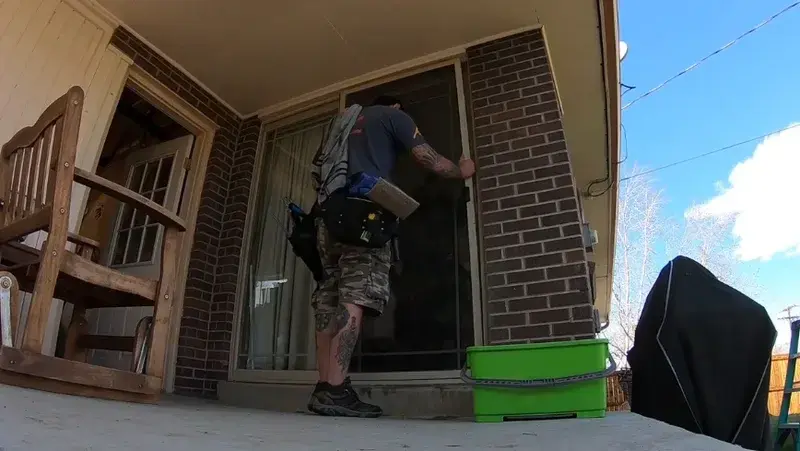
Can Window Cleaning Remove Scratches From Glass?
No. Normal window cleaning cannot remove a true scratch from glass.
Window cleaning removes dirt, film, fingerprints, loose residue, and other contamination sitting on an accessible glass surface. A true scratch is physical damage to the glass itself. Washing the pane again will not repair that damage.
Some scratches may be candidates for specialized glass polishing or restoration. Specialized polishing works the affected glass surface to reduce or, in suitable cases, eliminate the visible defect. That is different from routine window cleaning, and not every scratch should be polished.
There is also an important step before deciding that the glass is scratched: Clean the accessible surface appropriately and identify what remains. Mineral deposits, construction residue, adhesive, streaks, coating-related marks, and other material can sometimes look like scratches. Existing scratches can also become easier to see once dirty glass is clean. Window cleaning can remove material that looks like a scratch. It cannot wash away a true scratch.
Is That Mark Actually a Scratch?
A line on a window is something you can observe.
Calling it a scratch is a diagnosis.
Several glass conditions can look similar from across a room:
- mineral deposits
- paint or construction residue
- adhesive
- silicone or sealant residue
- streaks
- metal transfer
- coating-related marks
- physical scratches
A homeowner may see a thin white line and assume the glass has been scratched. Another mark may look like a scratch when afternoon sunlight hits the pane but almost disappear under gray skies.
Do not start with an abrasive or polishing compound just because the mark looks linear.
First determine whether something is on the glass or whether the glass itself has been damaged.
What Does a Real Glass Scratch Look Like?
A scratch is physical surface damage.
It may appear as a fine line, a longer groove, a group of parallel marks, or a more obvious damaged area. It may reflect light differently from the surrounding glass.
Some scratches are easy to see. Others become noticeable only when the lighting changes.
Vitro Architectural Glass, citing National Glass Association guidance, notes that light scratches can be difficult to detect under a dark or gray sky and become much more noticeable when sunlight reaches the glass at certain angles.
That is why glass should be evaluated in useful daylight and from more than one viewing angle.
Appearance alone, however, does not tell you how deep a scratch is or whether restoration is appropriate.
Why Should Glass Be Clean Before Diagnosing a Scratch?
Because dirt can interfere with the diagnosis.
Ordinary window cleaning can remove dust, fingerprints, film, loose residue, and other surface contamination.
Once those materials are gone, you have a better view of the actual glass surface.
Two very different things can happen.
The Mark Disappears
It was removable surface contamination rather than a permanent scratch.
The Mark Remains
Now you can investigate whether the remaining condition is a scratch, mineral deposit, etching, coating issue, or another glass condition.
This also explains why a scratch can seem to “appear” after a window has been cleaned.
Cleaning can reveal a scratch. Revealing a scratch is not the same as causing it.
What Is the Difference Between Window Cleaning and Scratch Removal?
The two processes solve different problems.
| Process | What It Addresses |
|---|---|
| Routine window cleaning | Dirt and ordinary surface contamination |
| Deposit removal | Material attached to the glass |
| Glass polishing or restoration | Certain physical surface defects |
| Glass replacement evaluation | Damage that may not be practical or appropriate to restore |
Routine cleaning tries to remove unwanted material while leaving the glass surface unchanged.
Scratch restoration is different.
The International Window Cleaning Association places stain and scratch removal under non-routine window cleaning and architectural glass surface restoration. It also treats mechanical polishing as specialized restoration work.
In consumer language, this work is often called scratch removal. Technically, specialized glass polishing works the affected glass surface to reduce or, in suitable cases, eliminate the visible defect.
Cleaning removes contamination from the glass. Scratch restoration works on damaged glass.
A company that provides professional window cleaning does not automatically provide glass scratch restoration.
Can Light Scratches Be Removed From Window Glass?
Some light scratches may be candidates for specialized glass polishing.
But “light” should not be treated as a promise that a scratch can be removed safely.
Restoration suitability can depend on:
scratch depth
scratch length
number of scratches
total damaged area
location on the pane
glass construction
coatings
surrounding damage
required optical appearance
The International Window Cleaning Association recognizes mechanical polishing as a glass restoration method used for scratches and other surface damage.
That is not the same as applying a stronger window cleaner.
Can Deep Scratches Be Removed From Glass?
Deeper scratches can be more difficult to restore.
As more glass must be worked to reduce a defect, maintaining an acceptable optical result becomes more important.
Uneven polishing can leave an area that looks visually different from the surrounding pane. That is one reason mechanical glass polishing is specialized restoration work rather than routine cleaning.
Making the line less visible is only part of the job. The glass still needs to look acceptable afterward.
A deep scratch does not automatically mean the whole window needs replacement, but it should not automatically be treated as a polishing job either.
Can You Tell Scratch Depth With the Fingernail Test?
Not reliably enough to make the whole decision.
You may see online advice that says:
fingernail catches = scratch cannot be repaired
or
fingernail does not catch = scratch can be polished out
That is too simple.
Whether your fingernail catches a groove can provide a rough clue about depth. It does not tell you everything needed to decide whether restoration is appropriate.
A better assessment considers:
depth + extent + glass type + coating + location + surrounding condition + desired optical result
Use the fingernail test as an observation, not a repairability guarantee.
Why Do Scratches Sometimes Look Worse After Window Cleaning?
Clean glass can make existing scratches easier to see.
Dirt or film may have reduced the contrast around a fine mark. Once that contamination is removed, the scratch can become more obvious.
Lighting also matters.
Vitro, citing NGA cleaning guidance, notes that scratches that are difficult to see against a gray sky may become noticeable when sunlight reaches the pane at certain angles.
That can be especially noticeable on large San Clemente view windows.
A fine mark overlooking the Pacific may be difficult to notice on a gray morning and obvious when afternoon light crosses the pane.
The sun may reveal a scratch. It does not mean sunlight created it.
Likewise, noticing a scratch after cleaning does not by itself establish when or how the damage occurred.
Can Window Cleaning Scratch Glass?
Improper cleaning can damage glass.
The National Glass Association warns against trapping abrasive particles between cleaning materials and glass. It also advises against abrasive maintenance-cleaning materials and against allowing metal parts of cleaning equipment to contact the glass.
The basic risk is straightforward:
abrasive particle → trapped against glass → movement across surface → possible scratch
The particle may be picked up by a cloth, washer, brush, pad, or another cleaning tool.
This is why clean tools, enough cleaning solution, and proper glass-cleaning procedures matter.
Can Dirt, Grit, or an Abrasive Pad Scratch Glass?
Abrasive material can damage glass when it is trapped and dragged across the surface.
The problem is not simply that the window is dirty. The risk comes from abrasive material moving against the pane.
An unsuitable abrasive pad can also scratch glass or damage a coating.
That does not mean every abrasive is inappropriate in every circumstance. Controlled glass-restoration processes may use specialized abrasives or polishing systems. Those processes are different from routine maintenance cleaning.
An abrasive used intentionally during specialized restoration is not the same as grit accidentally dragged across a window during cleaning.
Can a Squeegee Scratch Window Glass?
A clean rubber squeegee used correctly is part of normal window cleaning.
The more useful question is what is actually contacting the glass while the tool moves across it.
NGA advises against allowing metal components of cleaning equipment to touch the glass and warns about abrasive particles trapped between cleaning materials and the surface.
Clean equipment and control of grit matter.
Can a Razor Blade Scratch Window Glass?
Metal blades should not be treated as universally safe for architectural glass.
The National Glass Association says razor blades should not be used on coated glass surfaces and advises against metal contact during routine cleaning.
Vitro also states that razor blades and metal scrapers should not be part of routine maintenance cleaning.
The International Window Cleaning Association treats more aggressive scraper use as non-routine work under specific conditions rather than ordinary maintenance cleaning.
Real window systems may involve:
coatings
heat-treated glass
adhered particles
construction contamination
damaged blades
trapped debris
unknown surface conditions
The actual glass surface matters.
What About Tempered Glass?
“Tempered” describes how the glass was heat treated.
It does not mean the pane can automatically be scraped.
Cardinal Glass explains that heat treatment can leave tiny adhered particles or other surface conditions on glass. Scraping can dislodge particles and move them across the pane, potentially causing scratching or chipping.
Cardinal therefore advises against scrapers, abrasives, and harsh cleaning agents for its glass products.
This does not mean every tempered pane contains damaging fabrication debris. It also does not mean every tempered window will scratch if a scraper touches it.
It means blanket rules are a bad idea.
“Tempered” tells us how the glass was processed. It does not give blanket permission to scrape it.
Can Hard Water Spots Look Like Scratches?
They can create marks that a homeowner may mistake for glass damage, but a hard water deposit is not a scratch.
The distinction is important:
Hard water deposit: material has been left on the glass.
Scratch: the glass surface has been physically damaged.
Etching or surface alteration: the glass surface itself has changed.
These conditions do not require the same treatment.
Water containing dissolved minerals can reach a lower window or sliding glass door through sprinkler overspray. As that water dries, mineral deposits may remain on the surface.
Do not polish the glass simply because a mark did not disappear with ordinary glass cleaner.
First identify what remains.
See How Sprinklers Cause Hard Water Spots on Windows and Hard Water Stains vs. Glass Etching for those separate conditions.
Can Glass Etching Look Like Scratches?
Some types of surface damage can be visually confusing.
But etching and scratching should not be treated as interchangeable diagnoses.
A scratch often involves localized physical damage such as a line or groove.
Etching or another type of surface alteration can affect the glass differently.
A mark that cleaning does not remove is not automatically a scratch.
If ordinary contamination is gone and the mark remains, identify the remaining condition before choosing a restoration method.
Can Paint, Silicone, Adhesive, or Construction Residue Look Like Scratches?
Yes.
Construction contamination can create lines, smears, raised material, streaks, and irregular spots.
Paint, stucco, concrete, adhesive, sealant, and other building materials may end up on window glass during construction or remodeling.
Cardinal specifically warns that construction materials can reach glass and that improper methods used to remove them may also damage the surface.
That creates two separate risks.
The first is misdiagnosing residue as a scratch.
The second is creating a real scratch while aggressively trying to remove the residue.
See Post-Construction Window Cleaning, Paint Overspray on Window Glass, and Removing Stickers and Adhesive From New Windows for those specific problems.
Why Do Scratches Sometimes Appear After Post-Construction Window Cleaning?
Three situations can produce the same customer observation:
A scratch already existed.
A scratch was hidden by construction film or debris and became visible after cleaning.
A scratch was created during improper debris removal.
Finding a scratch after construction cleanup does not prove that cleaning created it.
It also does not prove the scratch was already there.
Inspection, documentation, glass condition, cleaning methods, and other evidence matter.
“I noticed it after cleaning” tells us when the scratch became visible. It does not, by itself, establish when the scratch occurred.
Can Low-E or Coated Glass Be Polished for Scratches?
Do not assume that a polishing method suitable for ordinary uncoated glass is suitable for coated glass.
First identify the surface.
Low-E is not one universal exposed coating configuration. Depending on the product, a coating may be protected inside an insulated glass unit or located on an exposed surface.
The useful questions are:
Is there a coating?
Which glass surface is coated?
Is the visible mark in the glass or in the coating?
What does the manufacturer permit?
NGA advises cleaners to determine whether a coated surface is exposed before cleaning and warns against using razors on coated glass surfaces.
Before treating the scratch, identify the surface you would actually be treating.
Can Scratches Between Double-Pane Windows Be Polished Out?
Not through normal window cleaning if the mark is on an inaccessible internal surface of a sealed insulated glass unit.
A double-pane IGU contains glass surfaces facing the sealed cavity.
Routine window cleaning reaches the accessible room-side and exterior surfaces. It does not open the sealed glass unit to polish an internal surface.
A restoration method cannot work on a surface it cannot safely access.
See Can Window Cleaning Fix Fog Between Window Panes? for more about accessible and inaccessible glass surfaces.
Do Toothpaste or Baking Soda Remove Scratches From Glass?
Do not treat household abrasives such as toothpaste or baking soda as universal scratch-removal methods for architectural glass.
They skip several important questions:
Is the mark actually a scratch?
What type of glass is this?
Is a coating exposed?
How abrasive is the material?
How much of the surface is being changed?
What will the repaired area look like afterward?
NGA maintenance-cleaning guidance advises against abrasive cleaning materials.
If the mark is removable residue, appropriate cleaning may solve it without polishing.
If it is a true scratch, an improvised abrasive is not the same as controlled glass restoration.
Replacing one visible scratch with a larger dull or hazy area is not a successful repair.
Is Cerium Oxide a Window Scratch Remover?
Cerium oxide is used in certain glass polishing and restoration processes. It should not be treated as a universal product for every scratch or every glass surface.
The appropriateness of polishing depends on the actual defect and glass.
Factors can include:
scratch depth
worked area
glass construction
coatings
abrasion and polishing method
heat control
final optical quality
Professional technical guidance also recognizes that excessive or localized polishing can create optical problems.
Knowing the name of a polishing compound is not the same as knowing whether a pane should be polished.
Can Dog Scratches Be Removed From Sliding Glass Doors?
Some light pet scratches may be candidates for specialized glass restoration, but routine window cleaning will not remove a true scratch.
Sliding glass doors are a useful example because marks can occur at pet height and range from very fine surface marks to more obvious damage.
Clean the accessible glass first and inspect what remains.
If the mark is a physical scratch, restoration suitability depends on factors such as depth, extent, glass construction, coatings, and the desired final appearance.
Does Coastal Sand or Salt Air Scratch San Clemente Windows?
Do not blame the coast automatically.
Salt residue on glass is not the same thing as a scratch.
The more defensible concern is abrasive grit being dragged across the glass.
NGA warns about abrasive particles becoming trapped between cleaning material and glass.
So if gritty debris is present on a San Clemente window, whether the property is near North Beach, the Pier Bowl, or farther inland, the cleaning method should remove that contamination without grinding it across the pane.
The issue is abrasive material moving against the glass, not simply living near the Pacific Ocean.
When Is Scratch Removal Different From Window Cleaning?
The boundary is straightforward.
Routine window cleaning removes contamination.
Scratch restoration works on damaged glass.
IWCA includes stain and scratch removal under non-routine architectural glass restoration rather than ordinary maintenance cleaning.
That means hiring a window cleaning company does not automatically mean you have hired a glass polishing company.
Likewise, identifying a scratch does not mean that more cleaning is the correct next service.
Once clean glass reveals physical surface damage, the question changes from “How should this window be cleaned?” to “Is specialized glass restoration appropriate for this pane?”
When Might Glass Replacement Need to Be Considered?
A scratch does not automatically mean the whole window needs replacement.
Some damage may be suitable for restoration. Other conditions may need evaluation by a glass or window professional.
Relevant factors can include:
- deep or widespread damage
- cracks or chips
- edge damage
- coating damage
- inaccessible damaged surfaces
- risk of an unacceptable optical result
The correct decision also depends on the pane and window construction.
The purpose of this page is not to tell a homeowner to replace scratched glass.
It is to recognize when repeated cleaning is no longer addressing the actual problem.
What Should You Do If You Find a Scratch on Your Window?
Use a simple sequence.
Do not start with an abrasive. A mark that looks like a scratch may be removable contamination.
Clean ordinary surface contamination appropriately. Use a method suitable for the known glass surface.
Inspect the clean, dry glass. Look in useful daylight and from more than one angle.
See whether the mark changed. If it disappeared, it was removable surface material.
Look at what remains. Is it raised residue, a deposit, a line in the surface, broad haze, or something else?
Identify the glass or coating when possible. This matters before aggressive cleaning or polishing.
Avoid escalating blindly. Stronger abrasion is not automatically the next step.
Take clear photos. Different lighting angles can help document fine scratches.
Get the right assessment. If a true scratch remains, seek appropriate glass restoration or glazing advice rather than repeatedly cleaning it.
When Should You Stop Trying to Clean a Scratch?
Stop treating the mark as ordinary dirt when appropriate cleaning is no longer changing it.
That point may have arrived when:
the line remains on clean, dry glass
ordinary contamination has been removed
the glass or coating type is unknown
aggressive scraping or abrasion would be the next step
physical damage is visible
the affected surface is inaccessible
a DIY attempt is making the area larger or hazier
When cleaning stops changing the mark, stop increasing the aggression and reassess the condition.
How Do We Evaluate Glass That Appears Scratched?
We start by separating what window cleaning can address from what it cannot.
First, we look at the visible condition before aggressive treatment.
We consider whether dirt, film, mineral deposits, construction residue, or other surface contamination may be hiding or imitating the mark. Where relevant, the glass type and exposed coating also matter.
We then clean appropriate accessible surfaces within the agreed window-cleaning scope.
Once the glass is clean, we look again.
If the mark disappeared, it was removable surface contamination.
If a physical scratch remains, more routine window cleaning is not the answer.
We do not turn a scratch into “stubborn dirt” simply to keep working on the pane.
If the remaining condition appears to require specialized glass restoration or another glass service, that is a different scope of work.
Good window cleaning includes knowing when the problem is no longer a cleaning problem.
Can Window Cleaning Remove Scratches From Glass? FAQs
Can Professional Window Cleaners Remove Scratches From Glass?
Routine professional window cleaning cannot remove a true scratch. Some companies separately offer specialized glass polishing or restoration, but scratch restoration is different from ordinary window cleaning.
Can Light Scratches Be Polished Out of Windows?
Some light scratches may be candidates for specialized polishing. Whether polishing is appropriate depends on the scratch, glass construction, coating, affected area, and required final appearance.
Can Deep Scratches Be Removed From Window Glass?
Some deeper damage may be technically workable, while other damage may not be a practical restoration candidate. Deeper scratches can require more surface alteration and make optical quality a greater concern.
Why Do Scratches Look Worse After Window Cleaning?
Cleaning can remove film and dirt that were hiding fine scratches. Lighting also changes scratch visibility. A scratch noticed after cleaning was not necessarily created during cleaning.
Can Window Cleaning Cause Scratches?
Improper cleaning can scratch glass. NGA warns against unsuitable abrasive materials, trapped abrasive particles, and metal contact during maintenance cleaning.
Can a Razor Blade Scratch Tempered Glass?
Metal blades should not be assumed safe for tempered glass. Technical guidance warns that particles on heat-treated glass can be dislodged and dragged across the pane during scraping, potentially causing scratching or chipping.
Can Hard Water Spots Look Like Scratches?
Some deposits can create confusing marks, but a hard water deposit and a scratch are different conditions. A deposit is material on the glass. A scratch is physical surface damage.
Can Glass Etching Look Like Scratching?
Surface damage can sometimes look similar from a distance, but etching and scratching are not the same condition. A mark that survives cleaning still needs to be identified rather than automatically labeled a scratch.
Does Toothpaste Remove Scratches From Window Glass?
Do not treat toothpaste as a safe universal method for architectural glass. Its abrasiveness, coating compatibility, and effect on the final optical appearance are not controlled like a professional restoration process.
Can Cerium Oxide Remove Window Scratches?
Cerium oxide is used in some glass polishing and restoration processes, but it is not appropriate for every defect or glass surface. The actual damage, glass construction, coating, polishing method, and desired optical result matter.
Can Low-E Glass Be Polished?
Do not assume polishing is suitable until the actual glass product, coating location, and manufacturer guidance are known. Low-E coatings are not located on the same surface in every product.
When Should Scratched Window Glass Be Replaced Instead of Restored?
There is no universal scratch depth that automatically decides this. Extensive or deep damage, cracks, chips, edge damage, coatings, inaccessible surfaces, and the risk of poor optical results can all affect the decision. A qualified glass or restoration professional should assess the specific pane.
Not Sure Whether the Mark Is Dirt, Residue, or a Scratch?
A line or mark on a San Clemente window does not always need a stronger cleaner.
Surface contamination, sprinkler deposits, construction residue, etched glass, coating conditions, and true scratches need different responses.
We can clean appropriate accessible glass within the agreed window-cleaning scope and help identify when a remaining mark is no longer a routine cleaning problem.
If cleaning removes the mark, it was removable surface contamination. If a physical scratch remains, more routine cleaning is not the answer.