
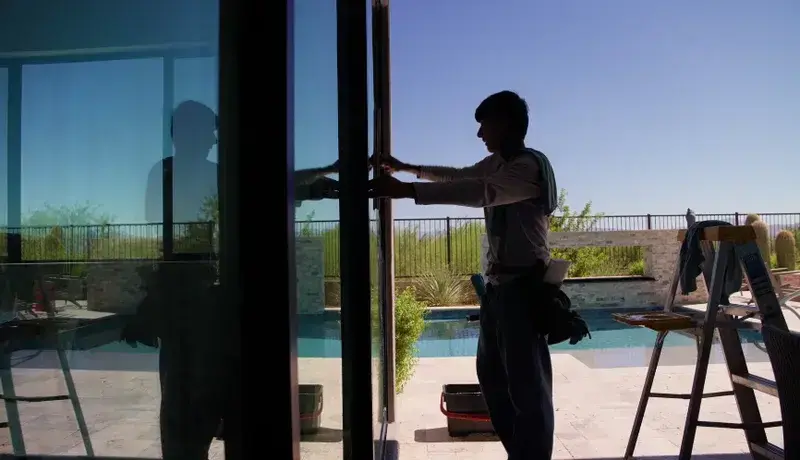
How to Remove Stickers, Adhesive & Protective Film From New Windows
Stickers, manufacturer labels, tape and protective film on new windows should be removed according to the window or glass manufacturer’s instructions whenever those instructions are available. Before using a scraper, solvent or stronger cleaning product, identify what is attached to the glass and whether the pane has a coating, permanent film or specialty surface.
Construction dust and grit also matter. Rubbing or scraping while loose particles are on the glass can increase the risk of scratching.
Start with the least aggressive appropriate method, work on a small area first, and stop if the glass type or residue is uncertain.
On new windows, identify the material and glass surface before choosing a removal method.
What Is Stuck to Your New Window?
Not everything attached to newly installed glass is the same.
You may be looking at:
- a manufacturer label
- a product sticker
- an installer label
- tape
- adhesive residue
- temporary protective film
- masking material
- construction dust
- paint, caulk or sealant
- another construction residue
Identifying the material comes first because different materials can attach differently, leave different residue and require different removal methods.
A sticker, adhesive residue and protective film may look like one problem, but they should not automatically be treated the same way.
Manufacturer Labels vs Stickers vs Tape vs Protective Film
Material
What You May See
Main Consideration
Manufacturer label
Printed label attached to glass
Check removal instructions
Sticker
Paper or plastic label
Adhesive may remain
Tape
Strip or tape residue
Adhesive may transfer to glass
Adhesive residue
Sticky or cloudy patch
Confirm a compatible removal method
Protective film
Larger clear or tinted layer
Identify the film and follow product instructions
Construction dust
Fine loose particles
Address before rubbing or scraping
Paint like specks
Small attached droplets
Diagnose separately
The thing you peel from the window and the residue left behind can be two different cleaning problems.
What Are Manufacturer Labels on New Windows?
Labels on new windows may contain manufacturer identification, product information, energy performance ratings, installation information or care instructions.
The National Fenestration Rating Council uses window labels to communicate ratings such as U Factor, Solar Heat Gain Coefficient and Visible Transmittance. Those details can help identify the product later.
Before throwing a useful label away, consider taking a clear photo of it.
Record information such as:
- manufacturer
- product or series information
- certification information
- performance ratings
- care instructions
- other useful identifying details
Should Manufacturer Labels Be Removed Immediately?
There is no universal answer for every label on every window.
Follow the window manufacturer’s or installer’s instructions about which labels should be removed and when.
If the label contains information you may need later, photograph or record it before disposal.
How Should Stickers Be Removed From New Window Glass?
A new window deserves more care than simply reaching for a razor blade or bottle of solvent.
Use this basic sequence.
Step 1: Identify the Sticker and Glass
First determine whether you are dealing with an ordinary sticker, manufacturer label, tape or part of a protective film system.
Then identify the glass where possible.
A new window may contain clear, tinted, tempered, laminated or coated glass. Some windows also have exposed Low E or other specialty surfaces.
Being new tells you the age of the window. It does not tell you what cleaning methods its glass surface allows.
Step 2: Check the Manufacturer’s Instructions
Look for care information from the window or glass manufacturer.
This is especially important with newly installed windows because the product information may still be available from the installer, builder, packaging or label.
Product specific instructions should take priority over generic online cleaning advice.
Step 3: Address Loose Construction Dust and Grit
New windows are often surrounded by dust and debris from installation, drywall, stucco, painting and other work.
Do not rub a sticker or adhesive patch through loose construction grit.
The National Glass Association recommends removing excessive dirt and debris before cleaning and warns against trapping abrasive particles between cleaning materials and the glass.
Step 4: Start With the Least Aggressive Appropriate Method
Do not automatically begin with:
- metal blades
- abrasive pads
- strong solvents
- adhesive removers
- hard scrubbing
Start with the method allowed for the specific product and condition.
Step 5: Work on a Small Area First
A controlled test can show how the material and surface respond before the same method is used across a larger area.
Watch for haze, discoloration, scratching, coating changes or unexpected effects on nearby materials.
Step 6: Treat Remaining Adhesive as a Separate Problem
The sticker may come off while some adhesive stays behind.
Do not assume that the same action used to remove the label is automatically the correct way to remove its adhesive.
Step 7: Inspect the Glass
Once the removable material is gone, inspect what remains.
A mark may turn out to be:
- adhesive
- ordinary dirt
- mineral spotting
- a scratch
- another construction residue
- a glass condition
If the mark is no longer behaving like surface residue, diagnose it before making the method more aggressive.
Why Does Adhesive Stay on Glass After a Sticker Is Removed?
The label and its adhesive do not always release together.
You might remove the paper or plastic portion and still see:
- a sticky patch
- a cloudy outline
- a dull looking area
- dirt attached to the residue
- a streak like film
That remaining material should be treated as adhesive residue rather than as another ordinary dirty window.
Is Adhesive Residue the Same as a Dirty Window?
No.
Normal dirt and adhesive contamination behave differently.
Repeatedly cleaning a sticky patch with an ordinary window cleaning method may not address the material causing it.
At the same time, do not assume every cloudy outline is adhesive.
A remaining mark could also be cleaning residue, mineral deposits, a scratch, construction contamination or another glass condition.
If the glass still appears hazy after the removable material is gone, see our guide to Why Windows Can Look Cloudy Even After Cleaning.
How Should Adhesive Residue Be Approached?
Start by asking what created the residue.
Then consider:
- the amount of adhesive
- the glass and coating
- the window manufacturer’s instructions
- nearby frames and seals
- the compatible removal product or method
- a controlled test area
- the final appearance after treatment
This matters because manufacturer recommendations are not identical.
Pella, for example, publishes product specific guidance allowing certain solvents for spot cleaning stubborn materials on specified glass. It also warns that solvents should be kept off wood, fiberglass and vinyl frames because finishes may discolor.
Other manufacturers place different restrictions on their products. Simonton specifically tells owners of its vinyl windows and doors not to use adhesive removers such as Goo Gone, nail polish remover or cleaners containing organic solvents because they may affect the appearance of the vinyl and glass.
That is why advice such as “just use Goo Gone” or “just use acetone” is too broad for new windows.
A solvent recommended for one window product may be restricted on another.
Is a Stronger Solvent the Next Step When Adhesive Will Not Come Off?
Not automatically.
A stronger chemical can interact with more than the adhesive. It may contact:
- an exposed glass coating
- permanent window film
- vinyl
- fiberglass
- wood
- seals
- painted finishes
- glazing materials
The goal is to remove the adhesive without creating a second problem on the glass or surrounding window components.
When an appropriate mild method does not work, diagnose why before moving to a stronger product.
What Is Protective Film on New Windows?
Some new windows arrive with temporary film applied to the glass.
This material may protect the surface during:
- manufacturing
- shipping
- handling
- installation
- construction
Cardinal Glass, for example, uses a product called Preserve. It is a factory applied polyethylene protective film with a water based adhesive designed to protect insulating glass during construction.
Marvin also documents clear protective film on some products that protects glass from construction debris, dust, dirt and stucco.
Temporary film can be useful during a remodel or new construction project because the glass may be installed before painters, stucco crews and other trades finish their work.
Is Protective Film the Same as Permanent Window Film?
No.
Do not confuse temporary construction protection with an intended permanent product such as:
- solar control film
- privacy film
- decorative film
- security film
- another functional window film
If you are unsure what the layer is, do not peel it simply because it looks removable.
Check the window documentation, manufacturer information or ask the installer or builder.
Temporary protective film and permanent window film are different products with different purposes.
Can Removing Protective Film Create Static Electricity?
It can with some protective film systems.
Andersen specifically warns that peeling protective film from certain window glass can create a static charge that may cause a shock or spark. The manufacturer also notes that the charge can pass through to the other side of the glass.
This matters because a new construction or remodeling area may also contain cleaners, solvents, foam insulation or other materials that should not be near a possible spark.
What Should Be Done Before Removing Film Where Static Is a Concern?
Follow the protective film and window manufacturer’s safety instructions.
Andersen advises making sure solvents, cleaners, foam insulation and other flammable materials are dry and properly stored before protective film removal. Its guidance also says misting the glass with water may help reduce static charge and the chance of a spark.
That is a product specific manufacturer precaution rather than a universal instruction for every film.
The broader rule is:
Before peeling protective film, check whether the manufacturer gives static electricity or flammable material precautions.
Can Static Charge Pass Through the Glass?
Andersen specifically warns that the static charge generated during removal can pass through to the other side of the glass.
That means the area on both sides of the window should be considered before removal when following this guidance.
This is easy to overlook when the person removing exterior film cannot see what is immediately beside the interior side of the pane.
When Should Protective Film Be Removed From New Windows?
Follow the removal period specified by the window, glass or protective film manufacturer.
There is no responsible universal rule such as “remove all protective film within 30 days.”
Different products have different requirements.
Cardinal currently says its Preserve film on the outdoor glass surface should be removed within six months of window installation for best results.
Marvin’s installation guidance says the protective film used on some products should typically be removed within nine months of application. Marvin also notes that certain exposed Low E coatings, tints and other glass products can shorten the allowed period.
These different instructions illustrate why the product matters.
Do not borrow one manufacturer’s removal deadline and apply it to every new window.
Can Sun, Heat or Humidity Affect Protective Film?
For some products, yes.
Cardinal reports that exposure to ultraviolet light, humidity and heat can increase adhesion of its Preserve film. It also identifies certain coatings and tints as factors that can affect adhesion.
That has practical relevance during a San Clemente remodel.
New windows may remain protected while exterior work continues through weeks or months of coastal weather and sun. A west facing window receiving afternoon sun may also experience different surface conditions from a shaded pane.
That does not mean San Clemente weather automatically causes a film problem. It means the manufacturer’s removal period should not be ignored while construction continues.
Does Removal Temperature Matter?
It can for some products.
Cardinal’s May 2025 technical guidance specifies a glass temperature range of 32°F to 140°F for removing its Preserve film and reports that adhesion generally increases as removal temperature falls.
That is a Cardinal specific instruction, not a universal temperature rule for every protective film.
The larger lesson is that some protective films have detailed removal conditions. Check the actual product before treating all film the same way.
What If Protective Film Has Been Left on Too Long?
Film that has remained on a window beyond the recommended period may become more difficult to remove, depending on the product and its exposure.
Possible conditions include:
- increased adhesion
- adhesive transfer
- film that releases unevenly
- material that tears during removal
- residue remaining on the glass
Do not respond by automatically pulling harder or reaching for a blade.
Use this sequence:
- identify the film → check manufacturer guidance → assess the glass and film condition → select an appropriate removal method
What If the Film Tears or Comes Off in Pieces?
Stop and assess why it is not releasing normally.
Age, exposure, temperature, coating type and the specific protective film may all matter.
The correct response is not automatically more force.
If a film is strongly bonded and the window product is known, check its current care instructions before continuing.
What Should You Do With Protective Film After Removing It?
Do not leave removed film lying around the property.
Andersen warns that protective film may present a suffocation hazard to children. Its guidance says the film should be disposed of immediately after removal and kept out of children’s reach.
This is particularly relevant during remodeling or move in work when construction materials, packaging and removed protective products may still be around the home.
Remove the film, follow the manufacturer’s cleanup instructions and dispose of the material promptly.
Why Does Construction Dust Matter Before Removing Stickers or Film?
Because new windows can be surrounded by fine particles long before the final cleaning happens.
Construction work may leave:
- fine dust
- grit
- loose particles
- dried residue
- debris around film edges
The National Glass Association warns against beginning cleaning without first addressing excessive dirt and debris and against trapping abrasive particles between cleaning materials and glass.
Can Loose Grit Scratch Glass During Sticker Removal?
It can increase the risk.
Particles caught beneath a cloth, pad, scraper or material being dragged across the surface can turn a simple cleanup into a glass problem.
Do not drag construction contamination across glass while trying to remove another material.
This is one reason final cleanup after a remodel should be treated differently from routine window washing.
Does the New Glass Have a Coating or Specialty Surface?
Possibly.
Modern architectural glass can include:
Low E coatings
tinted glass
reflective coatings
laminated glass
tempered or heat strengthened glass
decorative surfaces
permanent films
other specialty products
The National Glass Association recommends identifying the type of architectural glass and determining whether an exposed coating is present before cleaning.
Some coatings are not obvious just by looking at the pane.
Why Do Coatings Change the Removal Decision?
A method that is suitable for one exposed glass surface may be inappropriate for another.
Andersen’s High Performance Low E4 glass provides a clear example. Andersen says the exterior surface has a low maintenance coating and warns that abrasive or hard objects can damage it.
The manufacturer also specifically says not to use metal razor blades to remove its protective film.
What If You Do Not Know Whether the Glass Is Coated?
Do not guess.
Check:
- window labels
- purchase or installation documents
- manufacturer information
- builder or installer information
- before moving to an aggressive mechanical or chemical method.
For a broader discussion of incompatible cleaning products and tools, see What Should You Not Use to Clean Window Glass?
Why Do Manufacturer Instructions Matter So Much on New Windows?
Because manufacturers do not all give identical instructions.
Depending on the product, care guidance may specify:
- how labels should be removed
- when protective film should come off
- approved cleaners
- restricted chemicals
- blade or scraper restrictions
- care for exposed coatings
- instructions for frames and finishes
- film removal safety precautions
Consider the differences already discussed.
Cardinal says its Preserve film should be removed within six months of installation and warns against razor blades.
Marvin gives a typical nine month period for certain protective film and also warns against razor blade removal.
Andersen tells owners of relevant Low E4 products to peel protective film from a corner using a fingernail or clean plastic scraper rather than a metal razor blade. Andersen also publishes static charge and film disposal precautions.
Pella permits certain solvents for spot cleaning specified glass products while warning users to protect surrounding frames.
Simonton restricts several adhesive removers and solvents on its vinyl windows and doors.
Those differences should not be simplified into one DIY recipe. They show why the actual window product matters.
For new windows, product specific cleaning and film removal instructions should take priority over generic DIY recommendations.
What If You Cannot Find the Manufacturer’s Instructions?
Stay conservative.
Identify as much as you can about the glass, coating, film, frame and residue. Start with the least aggressive appropriate method and use a controlled test.
If successful removal appears to require stronger chemicals or mechanical scraping and compatibility is still unknown, professional assessment may be the better next step.
Should You Use a Razor or Scraper on Stickers and Adhesive?
A razor or scraper should not be treated as a universal sticker, adhesive or protective film removal tool.
The answer depends on:
- glass type
- exposed coatings
- residue
- construction contamination
- manufacturer instructions
- condition of the surface
Several manufacturers specifically warn against razor blade use in relevant new window cleaning situations.
Cardinal says razor blades should not be used to remove its Preserve film because they can scratch or score the glass.
Marvin says not to use a razor blade to remove protective film on the products covered by its instructions.
Andersen says not to use metal razor blades to remove protective film from relevant Low E4 glass.
Pella warns against using a razor blade to scrape stubborn material from the glass products covered by its care guidance because permanent marks or scratches may result.
Is a Plastic Scraper Safe?
Sometimes a manufacturer may specifically allow one for a particular task.
Andersen says a clean plastic scraper can be used to start a corner of protective film on the relevant product. Cardinal also describes using a plastic scraper or plastic putty knife to start its Preserve film when increased adhesion makes removal difficult.
That does not mean every plastic tool is automatically safe on every pane.
Plastic is not a substitute for identifying the glass and following the product instructions.
Isn’t New Glass Safe to Scrape?
No.
“New” does not describe the surface well enough.
The pane may be coated, tempered, tinted or surrounded by construction grit. It may also already have scratches or other conditions from installation or jobsite activity.
New glass is not automatically scrape safe.
Should You Use Strong Chemicals or Adhesive Removers?
Only after confirming that the product is compatible with the specific window.
Do not choose an adhesive remover solely because it dissolves adhesive.
Ask whether it is appropriate for:
- the glass
- exposed coatings
- permanent film
- frames
- seals
- painted finishes
- nearby surfaces
Pella’s guidance shows why this distinction matters. A solvent may be permitted for spot cleaning certain glass while still being something the manufacturer tells you to keep away from the frame.
Simonton’s guidance provides the other side of the issue by specifically restricting several adhesive removers and organic solvents on its vinyl windows and doors.
Safe for a piece of glass does not automatically mean safe for the whole window.
Should You Mix Cleaning Chemicals to Remove Stubborn Adhesive?
No improvised chemical mixture is needed for this job.
Follow the cleaner’s label and the window manufacturer’s instructions.
Mixing products introduces another variable without solving the basic question of compatibility.
When an appropriate mild method fails, diagnose why before escalating to a stronger product.
Why Should Existing Scratches Be Identified Before Cleanup?
Because a newly installed window is not automatically an undamaged window.
Before removing stubborn labels, adhesive or film, look for:
- scratches
- chips
- haze
- construction marks
- mineral deposits
- coating concerns
- other visible conditions
If there is a concern, photograph the starting condition before cleanup.
Can Sticker Removal Repair a Scratch?
No.
A scratch is physical damage to the surface. Removing a sticker or adhesive cannot repair it.
This distinction matters during new construction and remodeling because contamination and damage can exist on the same pane.
Why Document the Window Before Cleanup?
Documentation creates a clearer record of what was present before treatment.
That can help distinguish:
- removable contamination
- existing scratches
- adhesive
- film
- other construction conditions
If a label contains useful manufacturer or product information, photograph that too.
For newly installed windows, this can also make later conversations with the builder, installer or manufacturer more specific if a product question comes up.
How Should New Windows Be Assessed Before Sticker or Film Removal?
For a new window with labels, adhesive or protective film, use this assessment.
Step 1: Identify the Material
Is it a label, sticker, tape, adhesive residue or temporary protective film?
Step 2: Identify the Glass
Is the exposed surface standard glass, coated glass, permanent film or something you cannot identify?
Step 3: Inspect for Construction Dust and Grit
Do not drag loose particles across the glass during removal.
Step 4: Check the Existing Glass Condition
Look for scratches, chips, haze, mineral deposits and other marks before treatment.
Step 5: Check the Frame and Surrounding Finishes
Consider where a cleaner or solvent could travel.
Step 6: Find Manufacturer or Glass Fabricator Guidance
For new windows, this should happen before aggressive treatment.
Check for any product specific film removal precautions as well.
Step 7: Prepare the Area for Safe Film Removal
Where the manufacturer warns about static electricity, follow its precautions concerning flammable materials and the surrounding area before peeling the film.
If elevated access is required, treat that as a separate safety issue.
Step 8: Select the Least Aggressive Appropriate Method
Do not begin with maximum force, abrasion or chemical strength.
Step 9: Test
Use a small controlled area to check how the material and surface respond.
Step 10: Treat the Appropriate Area
Continue only when the response is consistent with the expected result.
Step 11: Dispose of Removed Material
Do not leave large sheets of removed protective film around the property. Follow the manufacturer’s disposal and child safety instructions.
Step 12: Inspect the Result
Separate remaining removable residue from scratches, mineral deposits or another glass condition.
Assessment determines the removal method, not the other way around.
Why Test a Small Area First?
A test is not just about whether the sticker comes off.
It can help you watch for:
- adhesive response
- haze
- scratching
- surface changes
- coating concerns
- discoloration
- effects on nearby finishes
Inspect the area carefully before treating a larger section.
Does One Successful Test Mean Every Window Is the Same?
No.
A San Clemente home may have original windows in one area and replacement windows from a later remodel in another. Even during one project, different window types or glass configurations may be present.
Different panes can have different:
- glass
- coatings
- residue
- construction exposure
- previous conditions
A successful test tells you about the area you tested. It does not prove every pane on the property is identical.
Why Do Frames, Seals and Surrounding Finishes Matter?
The target may be a sticker on glass, but the window is an assembly.
Around that glass may be:
- vinyl
- fiberglass
- wood
- aluminum
- seals
- glazing materials
- painted finishes
- trim
- sills
- finished walls
A liquid applied to the center of a sticker can spread or run beyond it.
That is why chemical compatibility cannot be judged only by asking whether something is safe for glass.
The adhesive may be on the glass, but the remover rarely stays perfectly inside the sticker outline.
Can the Same Product Be Used on a Sticker Attached to the Frame?
Do not assume so.
Sticker removal from glass and sticker removal from vinyl, fiberglass, painted wood or another finished surface are different cleaning problems.
Check the instructions for the material the sticker is actually attached to.
What If Adhesive or Protective Film Leaves a Cloudy Mark?
Do not keep scrubbing until you know what remains.
Possible explanations include:
- remaining adhesive
- cleaning residue
- construction contamination
- mineral deposits
- scratches
- a coating condition
- internal fogging
Cardinal also documents a product specific condition it calls history or ghosting with Preserve film. Under some conditions, a faint line may appear where layers of its film overlapped when moisture is on the glass.
That is another reason a visible line after film removal should not automatically be treated as stubborn adhesive.
Does Adhesive Transfer Mean the Glass Is Damaged?
Not necessarily.
Cardinal reports that under certain exposure conditions adhesive from its Preserve film can transfer to the surface of some coated glass.
In Cardinal’s testing of Preserve on Neat+ coated glass under high humidity, sunlight and temperature exposure, the manufacturer reports that after the transferred adhesive was removed, the functionality of the tested Neat+ coating was normal.
That finding is specific to the product and testing Cardinal describes. It should not be generalized to every coating or every adhesive.
What it does demonstrate is the importance of separating surface residue from actual glass damage.
If the appearance no longer responds like surface residue, diagnose the glass before using a stronger method.
Related resources include Why Are My Windows Cloudy Even After Cleaning? and Hard Water Stains vs Glass Etching.
Should You Pressure Wash Protective Film Off New Windows?
Do not assume pressure washing is appropriate.
Cardinal specifically says its Preserve protective film should not be pressure washed.
Marvin likewise warns against using a pressure washer to clean debris from the protective film covered by its installation guidance.
Simonton more broadly warns against high pressure washing its vinyl windows and doors because the pressure can damage sealants.
Protective film is meant to be handled according to its removal instructions, not blasted from the window.
What If Protective Film Is on an Upper Story Window?
Access is a separate safety problem.
Do not let a simple film or sticker removal job turn into an unsafe reach from a ladder.
Andersen specifically cautions users to make sure ladders or scaffolding are secure when they are needed for protective film removal.
For a second story or difficult exterior window, consider both questions separately:
What is the correct removal method?
and
Can the glass be reached safely?
A method can be appropriate for the glass while the access is inappropriate for DIY work.
For more on elevated access, see Second Story and Hard to Reach Window Cleaning.
When Is Professional Post Construction Window Cleanup a Better Option?
Professional assessment becomes more useful when:
- many new windows are involved
- labels or film cover multiple panes
- adhesive is widespread
- the glass type is uncertain
- exposed coatings may be present
- construction dust or grit is significant
- existing scratches are visible
- paint, caulk or other residue is also present
- windows are high or difficult to reach
- stronger mechanical or chemical treatment appears necessary
This is common after larger remodels and new construction, where the final glass condition may involve more than stickers alone.
A hillside home in Talega or Rancho San Clemente may also have second story or difficult exterior access. A remodel closer to the coast may leave exterior glass exposed while several trades finish their work. In either case, access and glass condition should be assessed separately.
Professional cleanup should not mean simply reaching for stronger chemicals or more aggressive tools.
The advantage is identifying the glass, contamination and surrounding materials before selecting the removal method.
For complete jobsite cleanup, see Post Construction Window Cleaning San Clemente.
When Should You Stop DIY Sticker or Film Removal?
Stop and reassess when:
- you do not know whether the film is temporary
- you cannot identify the glass
- an exposed coating may be present
- appropriate gentle treatment does not affect the adhesive
- a scraper appears necessary but compatibility is unknown
- stronger chemicals appear necessary
- construction grit is mixed with the residue
- scratches become visible
- the surface develops haze or another change
- static or flammable material precautions are unclear
- safe access requires an uncomfortable ladder position or uncertain scaffolding
- the window is high or difficult to reach
- you cannot identify the mark that remains
The point is not that every sticker requires a professional.
Many labels and temporary materials can be straightforward when the manufacturer’s directions are known.
The stopping point comes when the problem is no longer straightforward.
Do not turn a sticker problem into a glass problem.
What Results Should You Expect?
There are several realistic outcomes.
The Label Comes Off Cleanly
This is the simplest result. The label releases and routine final cleaning addresses what remains.
The Label Comes Off but Adhesive Remains
Now the problem has changed.
Identify a compatible adhesive treatment instead of repeatedly using the label removal action.
The Residue Comes Off but Another Mark Remains
The remaining condition could be:
- mineral deposits
- a scratch
- other construction contamination
- coating related appearance
- another glass condition
Diagnose it before continuing.
Existing Glass Damage Remains
Cleaning cannot repair a scratch, chip, etching or other physical glass damage that was already present.
Sticker, Adhesive and Protective Film Decision Guide
| What You Find | Better Next Step |
|---|---|
| Manufacturer label | Check label and manufacturer instructions |
| Label with useful product information | Photograph the information before disposal |
| Ordinary sticker | Identify the glass and use an appropriate gentle approach |
| Sticker removed but sticky area remains | Treat the adhesive as a separate condition |
| Tape residue | Confirm a compatible removal method |
| Temporary protective film | Follow the manufacturer’s removal guidance |
| Unknown film | Do not peel until it is identified |
| Film left on for a long period | Check product guidance before increasing force |
| Manufacturer warns about static | Follow its film removal and flammable material precautions |
| Construction dust or grit | Address loose contamination before rubbing |
| Coated glass | Verify product compatibility |
| Existing scratches | Document and assess before treatment |
| Razor or scraper seems necessary | Check glass and manufacturer restrictions |
| Strong chemical seems necessary | Verify compatibility with the entire window |
| Removed film | Dispose of it promptly according to product safety guidance |
| High exterior window | Treat safe access as a separate issue |
| Cloudy mark remains afterward | Diagnose the remaining condition |
Stickers, Adhesive and Protective Film FAQs
How Do You Remove Stickers From New Window Glass?
Identify the sticker and glass first. Check the window manufacturer’s instructions, address loose construction contamination, then use the least aggressive appropriate method allowed for that surface. Treat any adhesive left behind as a separate problem.
How Do You Remove Sticky Residue After a Window Label?
First confirm that the remaining material is adhesive. Then check the manufacturer’s cleaning guidance and choose a compatible method for the glass, coating and nearby frame materials. Do not assume a universal solvent is safe for every new window.
Should Protective Film Be Removed From New Windows?
Temporary construction protective film is designed to be removed, but first confirm that the material is actually temporary protection rather than permanent tint, privacy, security or another functional film. Follow the product’s removal instructions.
When Should Protective Film Be Removed From New Windows?
There is no universal deadline for every product. Cardinal currently specifies six months after installation for its Preserve film, while Marvin gives a typical nine month period for protective film covered by its instructions and notes that certain glass products can shorten that period. Follow the actual manufacturer.
What Happens If Protective Film Is Left on Too Long?
Depending on the product and exposure, adhesion can increase and film may become harder to remove or leave adhesive behind. Do not automatically respond with more force or a blade.
Can Removing Window Protective Film Create Static Electricity?
It can with some products. Andersen warns that removing protective film from certain glass can create a static charge that may cause a shock or spark and can pass through to the other side of the glass. Follow the manufacturer’s precautions, particularly around flammable materials.
Should Removed Window Film Be Thrown Away Immediately?
Follow the manufacturer’s disposal guidance. Andersen specifically warns that removed protective film can pose a suffocation hazard to children and says it should be disposed of immediately and kept out of their reach.
Can I Use a Razor Blade to Remove Stickers From Windows?
Do not treat a razor as a universal sticker removal tool. Andersen, Cardinal, Marvin and Pella all publish relevant cautions against razor blade use in particular glass cleaning or protective film situations. Identify the product and follow its instructions.
Can I Use a Plastic Scraper on New Window Glass?
Only when appropriate for the specific product and condition. Andersen and Cardinal allow clean plastic tools for starting certain protective films, but that does not make every plastic scraper suitable for every glass surface.
Can Goo Gone Be Used on New Windows?
Do not assume so. Simonton specifically advises against adhesive removers such as Goo Gone on its vinyl windows and doors because they may affect the appearance of the vinyl and glass. Other manufacturers publish different cleaning instructions. Check the actual window product first.
Can Solvents Be Used to Remove Window Sticker Adhesive?
Some manufacturers permit particular solvents for specific products and surfaces, while others restrict certain solvents or adhesive removers. Check the current instructions for the actual window rather than treating acetone, alcohol, mineral spirits or another solvent as universally safe.
Can Stickers Damage New Window Glass?
A sticker, adhesive residue and physical glass damage are different conditions. An unsuitable removal method can create additional risk, which is why the glass and manufacturer instructions should be identified before aggressive treatment.
What If There Are Scratches Under the Sticker or Film?
Document and assess them separately. Removing surface material cannot repair a scratch that already exists in the glass.
How Do I Know Whether Window Film Is Temporary or Permanent?
Check the label, window documentation, manufacturer information or installer guidance. Do not peel an unknown film based only on its appearance.
Can Professional Window Cleaners Remove Construction Stickers and Adhesive?
Appropriate labels, protective film and adhesive residue may be addressed during post construction window cleaning depending on the glass, contamination, manufacturer guidance, access and agreed scope.
Stickers or Adhesive Still on Your New Windows?
If new or recently installed windows have manufacturer labels, adhesive, protective film or other construction residue and you are unsure about the glass type or appropriate removal method, Window Specialists San Clemente can assess the condition and determine whether post construction window cleaning is appropriate.
Monday through Saturday, 8:00 AM to 6:00 PM
Updated September 2026