
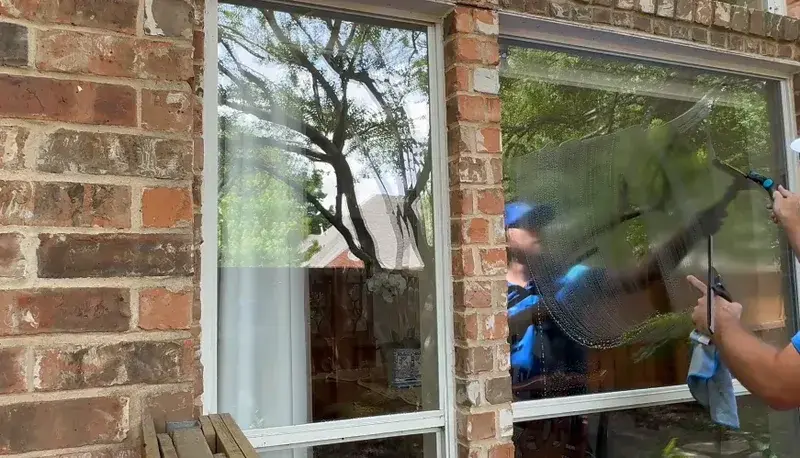
How Marine Layer Affects Windows in San Clemente
San Clemente’s marine layer can leave exterior glass damp or temporarily foggy and can change how existing material on a window looks. But the marine layer itself does not tell you whether a hazy window has coastal residue, ordinary dirt, hard water deposits, etched glass, or moisture between the panes.
The glass still needs to be judged by its actual condition and exposure.
Marine layer is a weather condition. Haze on glass is an observation. The cause of that haze still needs to be identified.
That distinction matters in San Clemente. A window near the Pier can have very different exposure from one in Talega, and even two windows on the same home can look different after the same cloudy morning.
What Is the Marine Layer in San Clemente?
The marine layer is a shallow layer of relatively cool, moist coastal air that sits below warmer air under a temperature inversion.
In simple terms, cooler marine air stays near the surface while warmer air sits above it. When the marine air becomes moist enough, low clouds called marine stratus can form.
The National Weather Service explains that Southern California’s prevailing westerly winds and daytime sea breeze can move marine stratus inland. Hills and mountains help limit or shape how far those clouds travel.
That is why San Clemente can start the day under low gray clouds while conditions farther inland, or later in the day, can look very different.
Is the Marine Layer the Same as Fog?
Not exactly.
The marine layer is the broader layer of cool, moist coastal air. Marine stratus is low cloud that can form within those conditions. Fog occurs when cloud is in contact with the ground.
For windows, the distinction matters. Seeing low clouds over San Clemente does not prove that moisture has collected on a particular pane.
Is June Gloom the Same as the Marine Layer?
June Gloom is a familiar Southern California term for persistent low clouds associated with marine layer conditions in late spring and early summer. May Gray describes a similar seasonal pattern.
But June Gloom describes what is happening in the atmosphere.
It is not the name of a substance deposited on window glass.
Does the Marine Layer Make Windows Dirty?
Not automatically.
A pane may simply be damp or temporarily foggy. Another may already have dust, pollen, coastal residue, or ordinary exterior grime that becomes easier to notice when moisture is present.
Those are different conditions.
A damp window is not automatically a dirty window.
If the moisture clears and the glass looks clean again, there may be little to address. If film, spots, streaks, or haze remain after the surface dries, then it makes sense to identify what remains.
Why Can Windows Look Hazy During the Marine Layer?
Temporary moisture can reduce clarity, but it is only one possible explanation.
Existing dirt or surface film may become more noticeable when the pane is damp. If the haze remains after conditions clear, possible causes include ordinary exterior buildup, coastal residue, mineral deposits from irrigation, cleaning residue, a changed glass surface, or moisture trapped between insulated panes.
“Hazy during the marine layer” describes when you noticed the problem. It does not yet identify the problem.
Is “Marine Layer Haze” a Real Window Condition?
It is useful as a description, but not as a precise diagnosis.
When someone says a window has “marine layer haze,” the actual condition could range from temporary exterior moisture to persistent surface contamination or fogging between panes.
A better starting question is:
Where is the haze, and does it remain after the glass is dry?
That answer tells you more about the window than the phrase “marine layer haze” alone.
Can Marine Layer Conditions Leave Salt or Coastal Residue on Windows?
Coastal moisture and marine aerosol are related, but they are not the same thing.
Sea salt aerosol exists in marine environments and can travel inland. Research into marine atmospheric exposure shows that factors such as distance from the sea, wind, and terrain can affect the movement and deposition of marine aerosol.
That does not mean every damp San Clemente window receives a new layer of salt.
A property close to the Pacific may have greater coastal exposure, but what reaches an individual pane depends on its location, orientation, wind exposure, protection, and surrounding conditions.
Marine layer does not equal a salt diagnosis.
Moisture can interact with material already on the glass without telling us what that material is.
Marine Layer Moisture vs. Coastal Residue: What’s the Difference?
These conditions can look similar from inside the house, but they describe different things.
| Condition | What It Describes | What May Happen When Conditions Change |
|---|---|---|
| Marine layer | Atmospheric condition | Low clouds and moist conditions can clear |
| Surface moisture | Water on an accessible glass surface | May evaporate |
| Coastal residue | Material deposited on the glass | May remain after the surface dries |
| Ordinary dirt | Surface contamination | Usually remains until removed |
| Hard water deposit | Mineral residue from mineral bearing water | Can remain after the water dries |
| Etching or physical surface change | A change to the glass itself | Routine cleaning does not simply wash it away |
| Between pane moisture | Moisture inside an insulated glass unit | Exterior cleaning cannot reach it |
The key question is not simply whether the morning was foggy.
It is what remains after the temporary weather condition passes.
Does the Marine Layer Cause Hard Water Spots?
Marine layer moisture and hard water should not be treated as the same mechanism.
The U.S. Geological Survey defines water hardness mainly by dissolved calcium and magnesium. When mineral bearing water repeatedly reaches glass and dries, mineral residue can remain.
Around a San Clemente home, sprinkler or irrigation exposure can therefore be an important clue when persistent white spots appear.
A white mark noticed during a cloudy coastal period should not automatically be called marine residue. In the same way, a home near the ocean does not turn every white spot into salt.
Weather tells us about exposure. Deposit pattern and water source help tell us what is on the glass.
For persistent mineral spotting, see Hard Water Stain Removal in San Clemente, Hard Water Stains vs. Glass Etching, and How to Prevent Hard Water Spots on Windows.
Marine Layer Haze vs. Fog Between Window Panes: How Can You Tell?
First identify which surface looks cloudy.
Haze on the Exterior Surface
Exterior haze may be temporary moisture or material sitting on the glass. If the surface is accessible, cleaning and drying it can help determine what remains.
Moisture on the Interior Surface
If moisture is on the room facing surface, indoor humidity and the temperature of the glass may be involved.
Haze Between Two Panes
If the cloudy appearance is trapped between panes, routine exterior cleaning cannot reach it.
A simple first step is to clean and dry both accessible surfaces. If the haze clearly remains between the panes, the problem is not ordinary exterior dirt.
Before choosing a cleaning solution, first identify which surface the haze is actually on.
See Why Are My Windows Cloudy Even After Cleaning? for a deeper diagnosis.
Does the Marine Layer Damage Window Glass?
The presence of a marine layer does not by itself prove that window glass is being damaged.
Published research has shown that marine aerosols and high humidity can affect some silicate glass surfaces under certain exposure conditions. But controlled studies and specific marine exposure sites do not establish a fixed damage timeline for every residential window in San Clemente.
Glass type, coatings, actual contaminants, exposure, and maintenance history can all matter.
That is why claims such as “marine layer will etch every coastal window within a certain number of days” should not be treated as a universal rule.
Do not diagnose etching from the weather forecast. Diagnose the glass.
Why Do Some San Clemente Windows Show More Coastal Buildup Than Others?
Exposure is not uniform.
Distance from the immediate coast can matter, but so can:
window orientation
wind exposure
elevation
overhangs and building protection
nearby structures
screens
landscaping
irrigation
maintenance history
This creates an important local distinction.
Two homes in the same San Clemente neighborhood can have different window exposure, and two windows on the same home can behave differently.
A neighborhood name is context. It is not a glass diagnosis.
How Does the Marine Layer Affect North Beach and Pier Bowl Windows?
North Beach and the Pier Bowl sit in an immediate coastal setting, so marine conditions are naturally relevant when evaluating exterior glass there.
But proximity to the Pacific is only part of the picture.
One pane may face open coastal air while another sits beneath an overhang. A protected courtyard window may behave differently from exposed glass facing the ocean, even at the same property.
The same principle applies around homes and businesses near Avenida Del Mar and the streets leading toward the Pier.
Being near the coast increases the relevance of coastal exposure. It does not diagnose an individual pane.
Does the Marine Layer Affect Talega, Forster Ranch and Inland Windows Too?
Yes. Marine layer clouds can extend inland.
The National Weather Service explains that onshore winds move marine stratus inland and that cloud depth and surrounding terrain help determine how far it travels.
So marine clouds can reach inland parts of San Clemente, including Talega and Forster Ranch.
But seeing marine clouds inland does not mean a window there has the same surface exposure as ocean facing glass near the Pier.
Landscaping, irrigation, elevation, orientation, surrounding buildings, and wind can produce a different window condition.
Does Elevation Change Marine Layer Exposure?
It can change the weather context.
Terrain helps influence how far marine stratus extends inland and how the cloud layer interacts with higher ground. That makes elevation relevant when thinking about hillside parts of San Clemente, including Rancho San Clemente.
But elevation alone does not tell you what will collect on a pane.
Elevation can change the weather context, but pane orientation and property exposure still matter when evaluating the window itself.
Why Can One Side of a Home Look Hazy While the Other Looks Clear?
Because the windows do not have identical exposure.
One side may face open coastal air while another is protected by the structure. One pane may receive sprinkler overspray. Another may sit beneath an overhang. Screens, landscaping, shade, sun, wind, and existing contamination can also differ around the same property.
Same marine layer. Different pane exposure. Different result.
This is why it is more useful to inspect individual window conditions than to assume the entire house has one type of “marine layer buildup.”
Does the Marine Layer Make Windows Need Cleaning More Often?
It can be one exposure factor, but the marine layer alone should not set the cleaning schedule.
A useful schedule considers:
actual buildup + property exposure + orientation + irrigation + screens + desired appearance
An ocean view homeowner who notices small changes in glass clarity may prefer a different schedule from someone with protected windows that remain visually clean longer.
There is no reliable citywide rule saying every coastal home needs window cleaning every six weeks, every two months, or every quarter.
For the full scheduling question, see How Often Should You Clean Windows in San Clemente?
Should You Clean Windows During the Marine Layer?
A marine layer does not automatically prevent window cleaning.
Actual moisture, wind, visibility, exterior access, height, and the requested work matter more than the gray sky itself.
Cloudy coastal weather is not the same thing as unsafe working weather.
For the broader effect of rain, wind, clouds, and sun on cleaning conditions, see Weather & Window Cleaning in San Clemente.
Should You Wait for the Marine Layer to Burn Off Before Cleaning Windows?
Not automatically.
Waiting can help when temporary moisture makes a particular mark difficult to inspect or when other conditions interfere with the work.
But marine layer clouds do not clear at the same time every day. Their depth, onshore flow, terrain, and broader weather pattern can affect how long they remain.
There is no universal clock time when San Clemente windows suddenly become suitable for cleaning.
What Happens When the Sun Comes Out After the Marine Layer?
Sunlight can warm the glass and speed drying.
If the pane only had temporary moisture on it, that moisture may simply evaporate. If nonvolatile material is already present on the surface, it can remain after the water disappears and may become easier to notice on dry glass.
That does not prove the sun created the deposit or permanently bonded it to the pane.
The useful question is still:
What remains after the glass is dry?
If visible film, spots, or haze remain, identify the material or glass condition rather than assuming the sun “baked” marine layer residue into the window.
How Can I Tell Whether Marine Layer Moisture or Surface Buildup Is the Problem?
Use the window, not the weather app, as your starting point.
1. Identify the Surface
Is the haze outside, on the room facing surface, or between two panes?
2. Let Temporary Moisture Clear
See whether the appearance changes after the glass dries.
3. Look at the Pattern
Uniform film, white spots, rings, streaks, and runoff marks can point toward different causes.
4. Check the Exposure
Is the pane ocean facing, protected, near landscaping, or within sprinkler reach?
5. Clean Ordinary Surface Contamination Appropriately
See what routine cleaning actually removes.
6. Reassess What Remains
Persistent marks need identification before stronger chemicals or abrasive methods are considered.
If the marine layer clears but the mark does not, stop diagnosing the weather and start diagnosing the glass.
What If the Haze Remains After the Glass Is Cleaned?
What remains can help narrow the problem.
If routine cleaning removes the film, ordinary surface contamination may have been the issue.
If white spots remain, investigate possible mineral exposure.
If a uniform haze remains on the accessible glass, further evaluation may be needed to distinguish persistent deposits from a changed glass surface.
If haze remains between the panes, exterior cleaning cannot reach it.
Scratches are physical damage. Paint, silicone, adhesive, and construction material are also different from normal window dirt.
Repeatedly cleaning the same pane without identifying what remains can waste time and create unrealistic expectations.
How Does Marine Layer Exposure Affect Window Screens?
Screens are separate surfaces with their own exposure.
Moist conditions can make existing dust, pollen, or debris more noticeable, but moisture alone does not tell you whether the screen needs cleaning.
A damp screen is not automatically a dirty screen, just as damp glass is not automatically dirty glass.
If debris remains after the screen dries, evaluate the screen separately instead of assuming the glass is the entire problem.
See Window Screen Cleaning in San Clemente for more.
Does the Marine Layer Affect Storefront Windows Too?
Yes. Storefront glass around San Clemente experiences the same local atmospheric conditions as residential exterior glass.
But a storefront around Avenida Del Mar may also deal with fingerprints, door traffic, street dust, nearby activity, and its own cleaning schedule.
Marine conditions can be part of the exposure without being responsible for every visible mark.
For commercial glass care, see Storefront Window Cleaning in San Clemente.
What Should San Clemente Homeowners Do During Marine Layer Season?
A simple process works better than assuming every cloudy morning has left a new deposit.
- Let temporary moisture clear.
- Identify which windows still show a persistent problem.
- Check coastal exposure, irrigation, screens, and surrounding conditions.
- Identify what remains before treating it as salt, hard water, or glass damage.
- Clean ordinary surface contamination appropriately.
- Reassess persistent spots, haze, or between pane moisture.
- Base maintenance on what the windows actually show rather than on the season alone.
When Is the Marine Layer Not the Real Window Problem?
Look beyond the weather when the pattern points toward another source.
White rings or spots near sprinkler coverage: possible mineral deposits.
Persistent exterior haze after cleaning: possible remaining deposit or changed glass condition.
Moisture between panes: an insulated glass issue rather than ordinary exterior contamination.
Scratches: physical glass damage.
Paint, silicone, or adhesive: specialty contamination.
Visible debris in the screen: a screen condition.
Marine layer describes the environment around the window. It does not explain every condition in the window.
How Should Hazy or Coastal Exposed Windows Be Evaluated?
Start with what can actually be observed.
When is the haze most visible? Which surface is affected? Does it disappear when temporary moisture clears? Is the pane exposed to open coastal air, irrigation, landscaping, runoff, or an overhang? Does routine cleaning remove the condition?
Those answers help separate ordinary surface contamination from persistent mineral deposits, between pane fogging, physical glass changes, or another problem.
The cleaning method should follow the condition of the glass and the access required, not a generic label such as “marine layer buildup.”
You do not need to call every coastal mark marine layer buildup to clean a window correctly. You need to identify what is actually on the glass.
How Marine Layer Affects Windows in San Clemente FAQs
Does the Marine Layer Make Windows Dirty?
Not automatically. It can create damp or foggy conditions and interact with existing surface material, but a wet window is not necessarily a dirty window.
Does Marine Layer Fog Leave Salt on Windows?
Fog or moisture alone does not prove that a mark is salt. Coastal glass can also be exposed to marine aerosol, but actual residue depends on the property’s exposure and needs to be identified.
Why Do My Windows Look Hazy During June Gloom?
Temporary moisture can reduce clarity, while existing dirt or residue may become more noticeable when glass is damp. If the haze remains after the pane dries, investigate what remains.
Is Marine Layer Haze the Same as Hard Water?
No. Hard water involves mineral bearing water. A cloudy coastal morning does not by itself diagnose a hard water deposit.
Is Marine Layer Haze the Same as Salt Film?
Not necessarily. “Marine layer haze” describes an appearance associated with certain weather conditions. It does not identify the material on the glass.
Can Marine Layer Moisture Damage Window Glass?
Marine aerosol and high humidity can affect some glass surfaces under certain exposure conditions, but a marine layer does not prove that a residential window is being damaged or establish a fixed damage timeline.
Can Windows Be Cleaned During the Marine Layer?
Sometimes. A marine layer alone does not prevent cleaning. Actual moisture, wind, visibility, access, and the requested work matter more.
Should I Wait for the Marine Layer to Burn Off?
Not automatically. Waiting can help when temporary moisture prevents a clear inspection, but there is no universal San Clemente time when all windows suddenly become ready for cleaning.
What If the Haze Remains After the Marine Layer Clears?
Identify which surface is affected and what remains. Persistent mineral spots, exterior film, physical glass changes, and between pane moisture require different responses.
Windows Still Look Hazy After the Marine Layer Clears?
If your San Clemente windows still show haze, spots, or film after the exterior glass is dry, the next step is identifying what remains.
Coastal residue, ordinary dirt, sprinkler minerals, changed glass surfaces, and moisture between panes do not all need the same solution.