
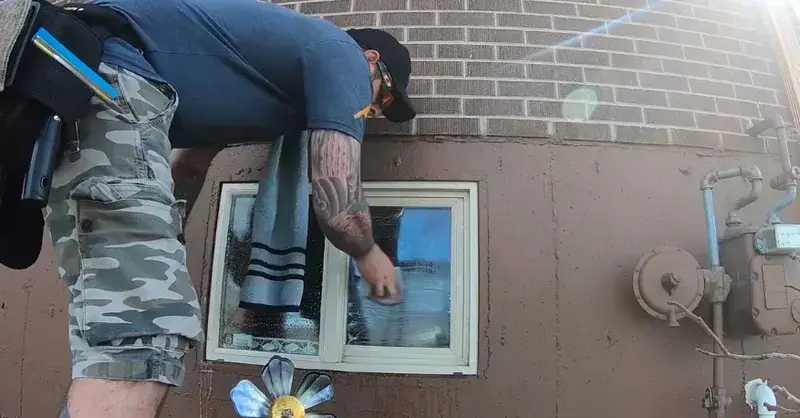
Can Window Cleaning Fix Fog Between Window Panes?
No. If fog or moisture is truly trapped between the panes of a sealed double pane or triple pane window, normal window cleaning cannot reach it.
Professional window cleaning can remove dirt, film, fingerprints, coastal residue, and other contamination from accessible glass surfaces. It cannot clean the sealed space inside an insulated glass unit.
But a window that looks foggy is not automatically fogged between the panes. Exterior moisture, room side condensation, hard water deposits, surface film, and other glass conditions can create a similar cloudy appearance.
Before deciding how to clean a foggy window, first identify which surface is actually foggy.
How Can You Tell If Fog Is Really Between the Window Panes?
Start with the simplest test.
1. Check the Room Side Surface
Look closely at the haze or moisture.
Can you touch it from inside the home? Does wiping the room side glass change the appearance?
If it does, at least part of the problem is on an accessible surface.
2. Check the Exterior Surface
If the exterior glass can be reached safely, inspect and clean that surface appropriately.
Dirt, coastal film, water spots, and temporary exterior moisture can all make glass look cloudy from inside the room.
3. Look Again When Both Accessible Surfaces Are Clean and Dry
If the cloudy appearance remains visually behind both clean surfaces, the condition may be inside the insulated glass unit.
Pella distinguishes this from ordinary surface condensation. Its current guidance says interior or exterior condensation is generally related to temperature and humidity, while condensation between panes of insulating glass usually indicates glass seal failure.
If you can reach the condition, cleaning may be relevant. If the condition is sealed behind the glass, ordinary window cleaning cannot reach it.
Where Is the Fog? Three Window Conditions That Look Similar
Location comes before diagnosis.
| What You See | Where It Is |
|---|---|
Can Window Cleaning Help?
Exterior moisture or surface film
Outside surface
Cleaning can remove accessible contamination. Temporary moisture may clear with changing conditions.
Interior condensation or film
Room side surface
Cleaning can remove surface material, but it does not correct the humidity or temperature conditions causing condensation.
Fog or moisture between sealed panes
Inside the glass unit
No. Normal window cleaning cannot reach the sealed cavity.
The word foggy describes an appearance.
It does not tell you where the problem is.
What Does Fog Between Double Pane Windows Usually Mean?
In a conventional sealed double pane or triple pane window, persistent condensation between the panes usually points to a problem with the insulated glass unit.
Pella states that condensation can develop between panes when the seal holding the insulated glass unit together fails and allows moisture to enter.
That is different from condensation sitting on the room side or exterior surface.
What Is an Insulated Glass Unit?
An insulated glass unit, often called an IGU, is a manufactured glass assembly containing two or more panes separated by a spacer system.
A typical unit can include:
glass pane → spacer and sealed cavity → second glass pane
Depending on the product, the cavity may contain air or an insulating gas such as argon.
The U.S. Department of Energy explains that gas fills such as argon or krypton can be used between glazing layers to reduce heat transfer.
Cardinal Glass describes modern IG units as systems that can include glass panes, spacers, primary and secondary seals, desiccant, and air or argon fill.
The important point for a homeowner is simpler:
The space between the panes is part of a sealed manufactured glass unit. It is not an ordinary surface a window cleaner can reach.
What Does the Desiccant Inside an Insulated Glass Unit Do?
Some insulated glass spacer systems contain drying material called desiccant.
Its purpose is to absorb trace moisture and help keep the cavity between the panes dry.
Cardinal Glass says the molecular sieve desiccant in its insulating glass spacer is designed to absorb moisture while leaving the gas fill intact.
This helps explain why a modern IGU is more than two sheets of glass placed next to each other.
The spacer, seals, desiccant, panes, and gas or air space work as a system.
Why Does Moisture Get Between Window Panes?
In a conventional sealed IGU, moisture between the panes can appear when the sealed unit no longer performs as intended.
The basic relationship is:
sealed glass unit → loss of seal integrity → moisture enters the cavity → changing temperature and moisture conditions → visible condensation or haze
Pella identifies seal failure as the primary reason condensation develops between panes of insulating glass.
But seeing fog does not tell you exactly why that seal condition developed.
Product design, age, installation, physical condition, materials, and environmental exposure can all matter.
Fog can tell you there is a problem inside the glass unit without telling you why that problem developed.
Why Can’t a Window Cleaner Remove Fog Between the Panes?
Because the affected surface is not accessible.
Normal professional window cleaning can reach the room side glass and accessible exterior glass. Depending on the agreed service, screens, tracks, frames, or sills may also be cleaned.
It does not involve opening a factory sealed insulated glass unit.
This is not a question of using a stronger glass cleaner.
It is not solved with more scrubbing.
A different squeegee does not change it.
This is an access boundary, not a stronger cleaner problem.
If the haze sits on one of the internal glass surfaces inside a sealed IGU, ordinary cleaning tools cannot physically reach it.
Why Does My Window Still Look Foggy After Professional Cleaning?
Because surface dirt may not have been the real cause of the cloudy appearance.
If the accessible glass has been properly cleaned but haze remains, possible explanations include:
moisture or haze between the panes
a persistent mineral deposit
changed or etched glass
scratches
a coating related condition
another condition that is not ordinary surface contamination
The next step is not automatically to clean the same surface again.
If accessible contamination has been removed but the cloudy appearance remains, continuing to clean the same surface may not solve the problem.
See Why Are My Windows Cloudy Even After Cleaning? for the broader diagnostic question.
Is Fog Between Window Panes the Same as Dirty Glass?
No.
Dirty glass has contamination on an accessible surface.
Fog between the panes exists inside the glass assembly.
A hard water deposit sits on a surface.
Etching involves a change to the glass surface itself.
These conditions may all reduce clarity, but they are not interchangeable.
A cloudy appearance does not automatically mean dirty glass.
Is Fog Between Panes the Same as Hard Water Haze?
No.
Hard water spotting involves mineral containing water reaching a glass surface, drying, and leaving material behind.
Between pane fog occurs inside the insulated glass unit.
That difference changes what can be cleaned.
Hard water is a surface deposit problem. Between pane fog is an insulated glass problem.
A white sprinkler spot and a milky internal haze can look similar from several feet away, but they have different sources and need different responses.
See How Sprinklers Cause Hard Water Spots on Windows and Hard Water Stain Removal in San Clemente for the surface deposit side of the issue.
Is Fog Between Panes the Same as Glass Etching?
No.
These three conditions should remain separate:
Deposit: material is sitting on a glass surface.
Etching or surface alteration: the glass surface itself has changed.
Between pane fog: moisture or haze is inside the insulated glass assembly.
Cleaning may remove an appropriate surface deposit.
Cleaning cannot reverse true glass alteration, and normal cleaning cannot reach a condition sealed inside an IGU.
See Hard Water Stains vs. Glass Etching for that distinction.
Is Fog Between Window Panes the Same as Condensation on the Inside of a Window?
No.
This wording causes a lot of confusion.
When a homeowner says condensation is “inside the window,” they may mean one of two very different places.
They may mean the room side surface that they can touch.
Or they may mean the sealed space between two panes.
Room side condensation forms on an accessible glass surface and is influenced by temperature and humidity conditions. Pella notes that a dehumidifier may help with room side condensation in appropriate situations.
A dehumidifier does not clean or repair a failed sealed glass cavity.
“Inside the house side of the glass” and “inside the glass unit” are not the same place.
Is Exterior Condensation a Failed Window Seal?
Not automatically.
Exterior condensation exists on the outside surface of the window.
Like dew on grass, it can develop when moisture in the air condenses on a sufficiently cool exterior glass surface. Pella notes that exterior condensation can evaporate as the outside temperature and glass temperature change.
That is different from moisture sealed between panes.
So a damp window on a foggy San Clemente morning should not immediately be diagnosed as a failed IGU.
Where the moisture appears matters more than simply seeing moisture.
Can San Clemente’s Marine Layer Make Windows Look Foggy?
Yes. Marine layer conditions can make exterior glass damp or temporarily reduce clarity when moisture is present on the outside surface.
That does not prove the window seal has failed.
This distinction is especially useful around coastal San Clemente.
A homeowner near North Beach or the Pier Bowl may first notice cloudy glass on a gray morning. Someone in Talega or Forster Ranch may notice a similar looking pane under different exposure conditions.
In both cases, the first question is the same:
Is the haze on a surface you can reach, or is it visually trapped between the panes?
Marine layer describes the weather around the window.
It does not diagnose the condition inside an insulated glass unit.
See How Marine Layer Affects Windows in San Clemente for the weather and exterior glass relationship.
Can Rain Cause Fog Between Window Panes?
Rain on the outside glass and moisture trapped inside an IGU are different conditions.
If a window looks cloudy during or after rain, first allow the exterior conditions to change and inspect the accessible surfaces.
If the outside glass is clean and dry but haze remains between the panes, the location of that haze matters more than the fact that it recently rained.
Do not jump from:
it rained → the seal failed
The weather may be when you noticed the problem without proving why the sealed unit developed it.
See Does Rain Make Windows Dirty? for the separate effect of rain on exterior glass.
Does Living Near the Coast Prove Why a Window Seal Failed?
No.
A San Clemente address provides environmental context. It does not explain why an individual IGU failed.
That applies whether the home is close to the Pacific, above the coast in Rancho San Clemente, or farther inland.
Pella notes that window life can depend on several factors, including product quality, materials, climate, installation, operation, and maintenance.
That is why we should not diagnose an individual failed seal as “salt air damage” or “marine layer damage” from location alone.
Coastal location provides context. It does not tell us why an individual insulated glass seal failed.
Why Does Between Pane Fog Sometimes Appear and Disappear?
Because the conditions that make internal condensation visible can change.
Temperature and moisture conditions do not remain constant throughout the day. A cloudy patch may become more obvious at one time and less obvious later.
That does not mean the sealed unit repaired itself.
Pella notes that window condensation is affected by temperature and humidity relationships. It separately identifies between pane condensation as an indication of seal failure in insulating glass.
A change in visibility does not necessarily mean the sealed unit has restored itself.
This is why a photo taken when the haze is clearly visible can be useful when seeking an assessment.
Why Is Fog Between Panes More Visible in the Morning or Certain Weather?
Changing glass temperatures and moisture conditions can change when condensation becomes visible.
Light can also change how easily haze is noticed.
A pane may look clear from one angle and obviously cloudy when direct light passes through it.
Do not automatically blame the marine layer, rain, or a single humid morning.
Weather may change when you notice the symptom without proving the original cause of the window condition.
Can Cleaning the Outside of the Window Make Between Pane Fog Go Away?
No, if the fog is genuinely between sealed panes.
Exterior cleaning can still be useful because it removes an exterior variable.
Suppose a window has coastal film outside and internal haze between the panes. Cleaning the exterior contamination may improve overall clarity, but the internal condition will remain.
That tells you something useful.
Exterior cleaning may help reveal the problem clearly, but it cannot repair a condition sealed inside the glass unit.
Can Cleaning the Inside Glass Fix the Fog?
Only if the condition is actually on the room side surface.
If wiping the inside glass removes the haze, then that part of the problem was accessible.
If both accessible sides are clean and dry but the haze still appears behind the glass, more surface cleaning is unlikely to solve it.
This is why locating the condition comes before choosing a cleaner.
Can You Open a Double Pane Window and Clean Between the Glass?
Not as part of normal window cleaning when the panes form a factory sealed IGU.
A conventional double pane window is not simply two removable sheets of glass with a dirty gap between them.
The glass unit is manufactured as a sealed assembly.
Cardinal’s description of an IGU shows why. The assembly can include multiple seals, a spacer, desiccant, and air or argon fill between the panes.
Opening or drilling into that assembly is not ordinary window cleaning.
Homeowners should not treat the sealed unit like a removable storm panel unless the product is actually designed that way.
There are exceptions. Some older window systems used removable glazing panels rather than a conventional permanently sealed IGU. Historical Pella documentation, for example, describes removable double glazing panels where condensation could have a different cause.
So identify the window system before assuming every double glazed product is constructed identically.
Can a Foggy Double Pane Window Be Defogged?
Services marketed as window defogging do exist.
They are different from normal window cleaning.
Some defogging methods create access through the glass, remove or dry moisture, and attempt to improve the appearance of the unit.
The important question is what the process actually restores.
This Old House notes that defogging can improve visibility but does not repair the original failed seal or replace lost insulating gas.
So homeowners considering defogging should ask:
Does this process restore the failed perimeter seal?
Does it restore the original gas fill where applicable?
Is the goal cosmetic clarity or restoration of the original IGU performance?
Could the work affect the manufacturer’s warranty?
Clearing visible fog and restoring a factory sealed insulated glass unit are not the same thing.
Does a Foggy Double Pane Window Need New Glass or a Whole New Window?
Fog between panes alone does not tell you that the entire window must be replaced.
The problem may be centered in the insulated glass unit while the surrounding sash or frame has a different condition.
Pella states that after insulating glass seal failure, the window or insulated glass unit typically needs replacement.
A qualified glass or window professional may need to evaluate:
the insulated glass unit
the sash
the frame
the hardware
the product design
the overall condition of the window
The correct answer depends on the actual window.
Do not turn a cleaning diagnosis into a whole window replacement recommendation without evaluating the window system.
Does a Failed Insulated Glass Seal Affect Window Performance?
It can.
The National Fenestration Rating Council’s consumer guidance says IG seal failure can result in loss of insulating gas and moisture penetration between panes. It also notes that moisture penetration can degrade Low E coatings.
That means between pane fog can be more than a cleaning or appearance issue.
But we should not claim that one foggy pane will cause a specific increase in a homeowner’s energy bill.
The actual effect depends on the glass system and its condition.
Should You Check the Window Warranty?
Yes.
Before paying for repair or replacement, identify the window manufacturer if possible and check the actual product warranty.
Look for:
manufacturer name
product information
serial or identifying numbers
purchase records
installation records
insulating glass or seal coverage
Warranty terms vary widely by manufacturer, product, purchase date, ownership, cause, and other conditions.
For example, Pella’s support guidance directs owners with warranty concerns to the written warranty for the specific product and notes that product identification or order information may be needed for a claim.
Other manufacturers also publish specific insulating glass seal coverage. That is why a homeowner should check the warranty for the actual window rather than relying on a generic statement online.
Do not assume a fogged window is covered, but do not pay for replacement before checking either.
Can You Prevent Fog Between Window Panes by Cleaning More Often?
No.
Routine window cleaning maintains accessible glass surfaces.
It does not maintain or repair the perimeter seal inside an insulated glass unit.
Cleaning more frequently can help prevent ordinary exterior dirt and film from confusing the diagnosis. It cannot be presented as a way to prevent IGU seal failure.
More frequent window cleaning is not a treatment for a failed insulated glass seal.
That boundary matters.
A window cleaning company should not manufacture more cleaning work when the problem is somewhere cleaning cannot reach.
Can Professional Window Cleaning Help at All When a Window Is Fogged Between Panes?
Yes, but within a clear boundary.
Professional cleaning can remove accessible contamination and help show whether surface dirt was contributing to the cloudy appearance.
After the accessible glass is clean, it may become easier to see that a remaining haze is somewhere beyond those surfaces.
A window cleaner can also tell a customer when repeated surface cleaning is no longer changing the condition.
That is different from certifying why an IGU failed or repairing the sealed unit.
We can identify when cleaning stops being the appropriate solution.
That is often more useful than repeatedly selling the wrong service.
How Do We Evaluate a Window That Still Looks Foggy After Cleaning?
We start with what can actually be seen and reached.
First, look at the affected pane and identify which accessible surface appears dirty or hazy.
Clean the agreed accessible glass where appropriate.
If temporary exterior moisture is present, allow conditions to clear enough to judge the glass.
Then reassess the remaining appearance.
Does the haze now appear to sit behind the accessible surfaces? Is there a persistent surface deposit instead? Does the mark look different from ordinary dirt? Does it remain in the same place when viewed from different angles?
The goal is to separate a cleaning problem from a condition outside normal window cleaning.
If the remaining haze appears to be inside a sealed glass unit, a glass or window professional is the appropriate next type of specialist to consult.
Our job is not to keep cleaning a surface after the evidence shows the problem is somewhere else.
What Should You Do If You Think the Fog Is Between the Panes?
Use this sequence:
- Check whether the haze wipes from the room side.
- Safely inspect the accessible exterior surface.
- Let temporary exterior moisture clear.
- Clean ordinary accessible surface contamination appropriately.
- Look at the window again from several angles and lighting conditions.
- If the haze remains visually inaccessible between panes, stop treating it like surface dirt.
- Identify the manufacturer and check the product warranty if possible.
- Contact an appropriate glass or window professional for an assessment of the sealed unit.
- Do not drill into or disassemble a sealed IGU simply to test whether the haze can be cleaned.
When Is Window Cleaning Actually the Right Solution for Cloudy Glass?
Window cleaning is appropriate when the condition is on a surface that can be safely reached and cleaned.
That can include ordinary dirt, dust, fingerprints, surface film, appropriate coastal contamination, and some removable deposits depending on their condition.
Cleaning cannot repair:
a failed sealed glass unit
a scratch in the glass
physical glass damage
true etching
a condition physically trapped inside an inaccessible glass cavity
The difference is not whether the window looks ugly enough to need cleaning.
The difference is where the problem is and what the problem actually is.
Fog Between Window Panes vs. Other Common Window Problems
| What You Notice | Likely Location | Cleaning Relevance |
|---|---|---|
| Dirt wipes away | Accessible surface | Routine cleaning can help |
| Exterior morning moisture | Exterior surface | Usually a weather and surface temperature condition |
| Interior condensation | Room side surface | Cleaning removes residue, not the moisture cause |
| White sprinkler spots | Exterior surface | Mineral deposit diagnosis may be needed |
| Coastal film | Exterior surface | Surface cleaning may help depending on condition |
| Persistent surface haze | Accessible surface or glass itself | Diagnose deposit versus surface alteration |
| Fog between sealed panes | Inside IGU | Normal window cleaning cannot reach it |
| Scratch | Glass itself | Cleaning will not remove it |
A San Clemente homeowner can have more than one of these conditions at the same time.
That is why location comes before diagnosis.
Can Window Cleaning Fix Fog Between Window Panes? FAQs
Can Window Cleaners Remove Fog Between Double Pane Windows?
Not when the fog is genuinely inside a conventional sealed insulated glass unit. Window cleaners can clean accessible interior and exterior surfaces, but normal cleaning cannot reach the sealed cavity between the panes.
Why Is My Window Foggy Between the Panes?
For a conventional sealed double or triple pane window, condensation between panes usually indicates that the insulated glass seal is no longer performing as intended and moisture has entered the cavity.
How Can I Tell If Condensation Is Inside the Window?
Clean and dry the accessible room side and exterior surfaces. If the haze remains visually behind both surfaces and cannot be touched from either side, it may be inside the insulated glass unit.
Is Condensation Between Window Panes a Broken Seal?
In a conventional sealed IGU, persistent condensation between panes is usually an indication of glass seal failure. Some older or specialized removable glazing systems can behave differently, so window construction still matters.
Can I Clean Inside a Double Pane Window?
Not through normal window cleaning when it is a factory sealed insulated glass unit. The inward facing glass surfaces are part of a sealed assembly and are not intended to be accessed like ordinary exposed glass.
Why Won’t My Foggy Window Clean Up?
The cloudy appearance may not be surface dirt. Possible causes include between pane moisture, persistent mineral deposits, scratches, glass alteration, or another condition that ordinary surface cleaning cannot remove.
Can Marine Layer Moisture Look Like a Failed Window Seal?
It can create a similar foggy appearance from a distance, but exterior marine moisture is on an accessible surface. Between pane condensation is inside the glass assembly. Check where the moisture is before diagnosing the window.
Is Hard Water Haze the Same as Fog Between Panes?
No. Hard water deposits occur on a glass surface exposed to mineral containing water. Between pane fog occurs inside an insulated glass unit.
Does Fog Between Panes Come and Go?
Its visibility can change as temperature, moisture, and lighting conditions change. Becoming less visible does not necessarily mean the sealed unit has repaired itself.
Can a Fogged Window Be Defogged?
Defogging services exist and may improve appearance in some cases. They are not normal window cleaning, and some methods do not restore the original perimeter seal or insulating gas. Ask exactly what the proposed process restores.
Can window cleaning fix scratched or fogged glass?
No. Surface cleaning does not repair scratches or failed insulated glass units with condensation trapped between the panes.
Does a Foggy Double Pane Window Need to Be Replaced?
The affected insulated glass unit may need replacement, but fog between panes alone does not prove that the entire frame and window assembly must be replaced. The surrounding window should be evaluated separately.
Why are my windows still cloudy after cleaning?
Residue or mineral deposits may remain on the surface. Another possibility is moisture trapped between insulated panes. Fog between sealed panes cannot be removed by cleaning the exposed glass.
Should I Check the Warranty for a Fogged Window?
Yes. Identify the manufacturer and product if possible, then check the actual written warranty. Coverage and exclusions vary, so do not assume either that the failure is covered or that it is not.
Window Still Looks Foggy After Both Sides Are Clean?
If a San Clemente window still looks cloudy after the accessible interior and exterior glass are clean and dry, more surface cleaning may not be the answer.
We can clean accessible glass within the agreed scope and help identify when the remaining appearance is outside normal window cleaning.
If you can touch the haze, cleaning may help. If the haze is sealed between the panes, it is a glass unit problem, not a dirty window problem.