
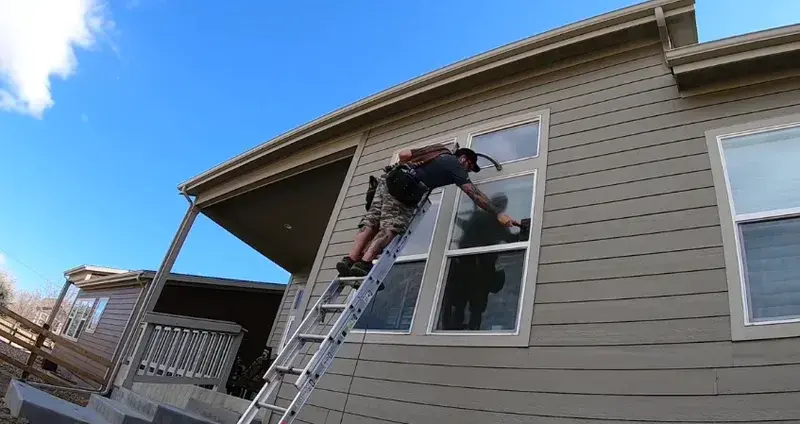
Tempered Glass and Window Cleaning: What Homeowners Should Know
Tempered glass can be professionally cleaned, but being tempered does not make a window scratch proof or make every cleaning tool appropriate.
Ordinary dirt, fingerprints, and exterior film can usually be handled with appropriate window cleaning methods. Paint, concrete, adhesive, mineral deposits, and construction residue are different. Those conditions may require a closer look at the glass, any exposed coating, and the material that needs to be removed before a more aggressive method is considered.
The National Glass Association specifically notes that heat treated glass surfaces require greater care during cleaning and recommends identifying both the glass type and any exposed coatings before cleaning begins.
Tempered describes the glass. It does not prescribe the cleaning method. That distinction matters most when routine cleaning stops being enough.
What Is Tempered Glass?
Tempered glass is heat treated safety glass.
It begins as ordinary glass. During tempering, the glass is heated and then cooled rapidly. This creates compression near the surfaces and tension inside the glass.
Those internal stresses change both its strength and the way it breaks.
The National Glass Association describes fully tempered glass as roughly four times the breakage strength of annealed glass of the same thickness. Pilkington similarly describes tempered glass as about four times stronger than standard annealed glass.
When fully tempered glass breaks, it is designed to fragment into many smaller pieces rather than the large, sharp shards associated with broken annealed glass.
That does not make tempered glass unbreakable.
It also does not make its surface impossible to scratch.
Tempering changes strength and breakage behavior. It does not make the exposed surface scratch proof.
Why Is Tempered Glass Used in Homes?
Tempered glass is commonly used where safety glazing is required or additional strength is needed.
Federal Consumer Product Safety Commission rules cover safety glazing used in products such as doors, bathtub and shower enclosures, and patio type sliding glass doors.
California building codes also identify specific hazardous glazing locations. Depending on dimensions and other conditions, these can include glazing in or near doors, certain low windows, wet areas, stairs, ramps, guards, and areas near pools and spas.
That does not mean every window beside a door or every low window in San Clemente must automatically be tempered. Code requirements depend on the actual location, dimensions, construction, and applicable rules.
In a San Clemente home, you may encounter safety glazing in a sliding patio door facing the yard, a shower enclosure, glazing near stairs, or certain glass near a pool or spa.
The location can help explain why safety glazing may have been selected.
It does not tell us which cleaning tool is automatically safe.
Is Tempered Glass the Same as Safety Glass?
Not exactly.
Tempered glass is one type of safety glazing.
Laminated glass can also be used as safety glazing, but it works differently.
Tempered glass gains its characteristic safety behavior through heat treatment. When it breaks, it fragments into many smaller pieces.
Laminated glass uses an interlayer between layers of glass. When laminated glass breaks, the interlayer helps hold the fragments together.
So:
Safety glass does not automatically mean tempered glass.
The distinction matters because different glass constructions can have different cleaning considerations.
Is Tempered Glass the Same as Heat Strengthened Glass?
No.
Both products are heat treated, but they are not interchangeable.
The National Glass Association describes heat strengthened glass as roughly twice the breakage strength of comparable annealed glass. Fully tempered glass is roughly four times the breakage strength.
Their break patterns are also different.
Heat strengthened glass generally produces larger fragments and is not, by itself, considered safety glazing in the same way fully tempered glass can be.
A useful distinction is:
Heat treated does not automatically mean fully tempered.
This is another reason not to identify a window simply by looking at how thick or strong it appears.
How Can You Tell If a Window Is Tempered Glass?
Start by looking for a permanent safety glazing mark.
On residential glass, this mark is often found near a corner or edge of the pane. It may contain information about the manufacturer or fabricator and the safety standard the glass meets.
California building code requires safety glazing installed in defined hazardous locations to carry identification meeting specific requirements. For tempered glass, the designation is intended to be permanent.
You may see references such as:
- ANSI Z97.1
- CPSC 16 CFR Part 1201
- manufacturer or fabricator identification
- safety glazing certification information
Manufacturer records, original window documentation, builder information, or glass supplier information can also help when the pane itself is difficult to identify.
Where Is the Tempered Glass Marking?
Look around the corners of the pane.
The mark may be small and easy to overlook, especially on a large sliding glass door or tall window.
Current California code allows permanent identification methods such as acid etching, sandblasting, ceramic firing, laser etching, or embossing.
A proper permanent temper mark is not simply a sticker that should wipe away during normal window cleaning.
Still, failure to spot a logo during a quick inspection should not become the entire diagnosis. Industry cleaning guidance notes that a logo may not always be visible or present on every heat treated product.
A visible temper mark can provide useful evidence. The absence of an obvious mark should not become the entire cleaning assessment.
Can You Tell Tempered Glass Just by Looking at It?
Not reliably enough for a cleaning decision where the wrong method could damage the surface.
Do not identify tempered glass solely by:
- tint
- thickness
- tapping on it
- where the window is located
- how reflective it looks
Its location may provide a clue. For example, a patio slider or shower enclosure is a place where safety glazing is commonly encountered.
A clue is not the same as product identification.
If the cleaning method depends on knowing the glass type, appearance alone is not enough.
Does Tempered Glass Need Special Window Cleaning?
Not necessarily for routine dirt.
Tempered glass does not automatically require a completely different cleaning system simply because it has been heat treated.
The distinction becomes more important when the work moves from routine cleaning into stubborn contamination or restoration.
Routine Window Cleaning
Routine contamination can include:
- dust
- fingerprints
- normal exterior dirt
- loose debris
- ordinary surface film
These conditions normally call for appropriate window cleaning rather than aggressive surface treatment.
Non Routine Window Cleaning
A different assessment may be needed for:
- paint
- stucco
- concrete or mortar residue
- silicone
- adhesive
- construction debris
- stubborn mineral deposits
- restoration work
The National Glass Association recommends determining the type of glass and any exposed coating before cleaning. Its current guidance also says heat treated surfaces require greater care.
The more aggressive the proposed cleaning method becomes, the more important glass identification becomes.
Can Tempered Glass Scratch?
Yes.
This is one of the most important misconceptions to clear up.
Tempered glass is stronger than comparable annealed glass, but strength and scratch resistance are not the same thing.
A tempered pane can still be scratched by an inappropriate abrasive, hard particle, contaminated tool, or unsuitable cleaning method.
It is not:
- scratch proof
- scraper proof
- abrasion proof
Tempered glass is stronger safety glass, not scratch proof glass.
If a mark is already present, first determine whether it is actually a scratch. Mineral deposits, transferred material, construction residue, and other surface conditions can sometimes look similar from across the room.
See Can Window Cleaning Remove Scratches From Glass? for that diagnosis.
Why Can Tempered Glass Scratch During Cleaning?
Scratching requires contact between the glass and something capable of abrading its surface.
A useful relationship is:
abrasive material + contact + movement across glass = scratching risk
The abrasive material might be debris already on the window, contamination caught under a cleaning tool, or an inappropriate abrasive product.
This is why rinsing and keeping tools clean matter.
The National Glass Association warns that particles trapped between a blade and glass can create fine scratches.
The key lesson is not that tempered glass scratches every time it is cleaned.
It is this:
The word “tempered” does not remove debris, friction, or abrasion from the cleaning process.
What Is Fabrication Debris on Tempered Glass?
Fabrication debris is one of the most misunderstood subjects in window cleaning.
Glass that will be tempered goes through additional fabrication and heat treatment. The National Glass Association maintains specific technical guidance titled Heat Treated Glass Surfaces Are Different because heat treated surfaces can present cleaning considerations that differ from ordinary annealed glass.
In window cleaning discussions, fabrication debris generally refers to small particles or surface conditions associated with glass fabrication that can become important when a hard tool moves across the surface.
The concern is not simply that a particle exists.
The concern is what can happen if a hard particle is dislodged, becomes trapped beneath a tool, and is dragged across the pane.
That relationship looks like this:
This issue is especially important during post construction window cleaning because stubborn construction residue can tempt someone to use more aggressive mechanical removal.
But there is an important limit to the diagnosis:
Finding tempered glass does not prove that harmful fabrication debris is present.
Does All Tempered Glass Have Fabrication Debris?
No universal assumption should be made.
This is where online explanations often go too far.
Some heat treated glass can present surface conditions that require extra care. That does not establish that every tempered pane contains harmful fabrication debris.
It also does not establish that every scratch on tempered glass came from the manufacturing process.
The actual pane and its condition need to be assessed.
Tempered glass creates a reason to assess. It does not create a reason to assume.
That distinction protects homeowners from two bad conclusions:
“Tempered glass is safe to scrape because it is strong.”
and
“Any scratched tempered window must have defective fabrication debris.”
Neither conclusion follows from the word tempered alone.
What Is the Difference Between Fabrication Debris and Dirt?
They describe different sources.
Ordinary Dirt
Ordinary dirt reaches the window through normal use and exposure.
That can include dust, fingerprints, exterior film, pollen, and loose environmental material.
Fabrication-Related Conditions
Fabrication related surface debris or conditions originate during glass processing or manufacturing.
Construction Debris
Construction debris reaches the glass during building, remodeling, painting, stucco work, masonry, sealing, or other site activity.
Those categories should not be treated as interchangeable.
A San Clemente window with dust after a dry, windy period is not automatically a fabrication debris problem.
A new patio slider covered with paint, silicone, or stucco residue after remodeling is not simply an unusually dirty window.
Where material came from matters because it changes both the diagnosis and the removal risk.
Can You Use a Razor Blade on Tempered Glass?
Do not treat a metal razor as a routine cleaning tool simply because the pane is tempered.
The National Glass Association’s current cleaning guidance says razor blades should be a last possible option, especially on heat treated glass. It also says razor blades should never be used on coated glass surfaces.
That second point matters because a tempered pane can also have a coating.
A homeowner may know the patio door is tempered without knowing whether the exposed surface carries another coating or treatment.
Stubborn paint, adhesive, silicone, or construction residue therefore deserves a different assessment from routine dirt.
“Tempered” is not permission to scrape.
The useful questions are:
- What glass is this?
- Is an exposed coating present?
- What material is on the surface?
- What does the manufacturer permit?
- What removal method is appropriate?
Does a Razor Blade Automatically Scratch Tempered Glass?
No universal claim should be made.
Saying that every razor always scratches every tempered pane is too broad.
Saying that razors are automatically safe on tempered glass is also too broad.
The result depends on the actual surface, contamination, debris, coating, tool, and method.
A blade can also trap a hard particle and move it across the glass. The National Glass Association specifically warns about this scratching mechanism.
So the better question is not:
“Does a razor always scratch tempered glass?”
It is:
“Is scraping appropriate for this glass, surface, and contamination?”
That is a much more useful cleaning decision.
Why Is Back and Forth Scraping a Concern?
The concern is trapped debris.
Industry cleaning guidance has warned that particles can become trapped beneath a blade and scratch glass as the blade moves.
That does not mean homeowners should learn a different razor technique from an article and start experimenting.
It means stubborn construction material should not be approached as ordinary window dirt.
If the cleaning method has reached the point where aggressive mechanical removal is being considered, the glass and surface should already have been assessed.
Can Abrasive Pads Scratch Tempered Glass?
Yes. An inappropriate abrasive can scratch glass.
Do not assume a household scrub pad is suitable because tempered glass is stronger than ordinary annealed glass.
Strength against breakage and resistance to surface abrasion are different properties.
An exposed coating adds another consideration.
The cleaning decision should follow:
not:
Can Dirt or Sand Scratch Tempered Glass During Cleaning?
Abrasive particles can contribute to scratching if they become trapped between a tool and the glass and are moved across the surface.
That distinction is useful in coastal Southern California.
A dusty window is normally a cleaning problem.
The risk changes when gritty or abrasive material is dragged over the pane under pressure.
This does not mean every particle of coastal dust or sand scratches a San Clemente window.
It means loose material should be removed appropriately rather than ground across the surface.
Dust on a window is usually a cleaning problem. Abrasive particles dragged across the glass can become a scratching problem.
Does Tempered Glass Change Post Construction Window Cleaning?
This is one of the situations where glass identification becomes especially important.
Post construction contamination may include:
- paint
- concrete
- mortar
- stucco residue
- silicone
- adhesives
- labels
- sealant
- construction dust and debris
These materials may not respond to the same process used for ordinary exterior dirt.
The National Glass Association specifically addresses protection and cleaning of architectural glass during construction because improper cleaning can permanently damage glass.
Imagine a remodeled San Clemente home with a large tempered patio slider facing the backyard.
If the glass has paint overspray, dried construction material, adhesive, and grit on it, the job is no longer simply “wash the window.”
The contaminant, glass, any coating, and proposed removal method all matter.
Construction debris on tempered glass is not simply extra dirty glass. It is a different cleaning problem with a different risk profile.
See Post Construction Window Cleaning San Clemente for the broader construction cleaning process.
Can Paint Overspray Be Removed From Tempered Glass?
Some paint contamination can be removed, but “tempered” does not tell you which removal method should be used.
The correct sequence is:
The answer should never be reduced to:
“It’s tempered, so scrape it.”
Paint removal has its own material and surface considerations.
See Paint Overspray on Window Glass for that specific problem.
What About Stickers, Adhesive, and Protective Film on Tempered Glass?
Use the same reasoning.
A sticker on tempered glass does not automatically make a scraper the right tool.
The window may also contain an exposed coating, film, or another surface treatment.
Start with:
Identify the material. Identify the window. Then choose the removal method.
That sequence is safer than choosing the tool first.
Can Tempered Glass Also Have a Low E Coating?
Yes.
These terms describe different properties.
Tempered describes heat treatment.
Low E describes a coating technology used to control radiant heat transfer.
The same window can involve both.
For example, a pane can be fully tempered for safety and also form part of a coated insulated glass unit.
This creates an important cleaning distinction.
Knowing that glass is tempered does not tell you whether an exposed coating is present.
Knowing that glass has a Low E coating does not tell you whether it is tempered.
See What Is Low E Glass and Does It Change Window Cleaning? for the coating and surface location discussion.
Which Matters More for Cleaning, Tempered Glass or an Exposed Coating?
Both can matter.
The surface actually being cleaned controls the immediate tool and material compatibility.
Suppose a window is tempered and also has an exposed functional coating.
The heat treated glass deserves appropriate cleaning care. At the same time, the coating manufacturer may place specific restrictions on blades, abrasives, chemicals, or polishing.
One property does not cancel the other.
Glass treatment and surface coating are separate pieces of the cleaning decision. Neither should be assumed from the other.
This is why identifying only one feature of a window is sometimes not enough before specialty cleaning.
Can Hard Water Spots Form on Tempered Glass?
Yes.
Tempering does not prevent mineral containing water from reaching the exposed glass and drying there.
Sprinkler overspray is a good example.
Water reaches the pane. The water evaporates. Dissolved minerals can remain as deposits.
The fact that the glass underneath is tempered does not create those minerals.
Tempered tells us about the pane. Hard water tells us about the contamination.
See How Sprinklers Cause Hard Water Spots on Windows for the water source and deposit process.
Does Tempered Glass Change Hard Water Removal?
It can be part of the overall assessment, but there is no reason to invent a special “tempered glass hard water treatment.”
First determine what is actually on the pane.
Then determine what surface is underneath it and whether coatings or other restrictions are present.
Routine window cleaning and mineral deposit restoration are not automatically the same service.
The deposit explains why additional treatment may be needed. The glass and exposed surface help determine which treatment is appropriate.
Can Tempered Glass Become Etched?
Tempered glass can develop surface damage, but a stubborn mark should not automatically be diagnosed as etching.
If something will not clean off, possibilities can include:
- mineral deposits
- scratches
- transferred material
- coating related conditions
- construction contamination
- physical surface alteration
Failure of routine cleaning is useful information.
It is not a complete diagnosis.
“It won’t clean off” tells us routine cleaning did not remove it. It does not tell us what the remaining condition is.
That is why persistent marks should be identified before stronger chemicals or abrasives are used.
Are Scratches More Visible After Tempered Glass Is Cleaned?
They can be.
Dirt and surface film can reduce contrast and hide fine scratches. Once the glass is clean, those scratches may become easier to see.
Lighting matters too.
A fine scratch that is difficult to notice under San Clemente’s morning marine layer may become much easier to see when stronger afternoon light hits the glass at an angle.
That does not establish when the scratch occurred.
Cleaning may reveal a preexisting scratch.
Improper cleaning can also create scratches.
The visible result alone does not prove either explanation.
A scratch becoming visible after cleaning does not by itself establish when the scratch occurred.
See Can Window Cleaning Remove Scratches From Glass? for the full scratch diagnosis.
What Are Quench Marks or Tempering Patterns?
Heat treated glass can sometimes show optical patterns created by the tempering process.
These may be called:
- quench marks
- strain patterns
- iridescence
- anisotropy
The National Glass Association explains that these patterns can become visible in heat strengthened and fully tempered glass under certain polarized lighting conditions.
ASTM C1048 does not treat the strain pattern itself as a glass defect or as something that changes the physical performance of the glass.
That distinction is important for homeowners.
A visible pattern is not automatically dirt.
It is not automatically cleaning damage either.
A tempering pattern is an optical characteristic of heat treated glass, not surface contamination that should automatically be scrubbed away.
Can Window Cleaning Remove Tempering Patterns?
No, if what you are seeing is genuinely a strain or quench pattern caused by heat treatment.
Cleaning removes material from an accessible surface.
It cannot wash away an optical characteristic created by the internal stress pattern of the glass.
Trying stronger cleaners because the pattern remains would address the wrong problem.
Why Can Tempered Glass Look Different in Certain Light?
Several things can change what you see when you look through or across a tempered pane:
- viewing angle
- sunlight
- polarized light
- strain or quench patterns
- surface contamination
- scratches
- reflection
- manufacturing related optical distortion
Heat treatment can also introduce characteristics such as roller wave, bow, or warp.
A large view window can make subtle optical differences easier to notice because there is more reflected scenery across the pane.
That can matter in San Clemente homes where glass frames an ocean, hillside, patio, or landscaped view.
But do not diagnose every distorted reflection as tempering.
A visual change under certain lighting conditions does not automatically mean the glass is dirty or damaged.
First determine whether the condition is on the surface or part of the way the glass itself is behaving optically.
Can Tempered Glass Be Cut or Drilled After Tempering?
Required cutting, drilling, notching, edge work, and other fabrication are performed before glass is heat treated.
The National Glass Association specifically states that fabrication such as cutting, hole drilling, notching, and edge treatment must be completed before heat treatment. Its technical guidance on fabrication also warns against performing glass fabrication after heat treatment because doing so may weaken the pane or cause it to break.
Why?
Tempering creates a controlled stress pattern within the finished pane. Its surfaces are placed into compression while the central portion is held in tension.
Trying to cut, drill, grind, notch, or significantly alter the finished glass interferes with that heat treated structure and can cause failure.
This also gives homeowners a useful way to think about tempered glass:
Tempered glass is fabricated to its required size and shape before tempering. It should not be treated like ordinary material that can simply be cut, drilled, or edge worked afterward.
This does not mean every small surface mark causes a tempered pane to break.
It does mean that the condition of the glass matters.
Why Does Edge or Surface Damage Matter on Tempered Glass?
Tempered glass depends on a controlled pattern of surface compression and internal tension.
Damage to glass can reduce its strength. Chips, deep scratches, damaged edges, installation damage, or other significant defects therefore deserve attention rather than being treated as cosmetic dirt.
This is particularly important near an edge because glass edges play an important role in the strength of the finished pane.
Once a fracture penetrates the compressive region of fully tempered glass and failure begins, the stored internal stresses contribute to its characteristic fragmentation.
That does not mean every tiny chip or scratch will cause immediate breakage.
It also does not mean edge damage matters only on tempered glass. Damage can weaken other glass products too.
The useful distinction is:
Tempered glass contains a deliberate internal stress pattern, so existing edge and surface damage should be treated as a glass condition, not something to attack with increasingly aggressive cleaning.
If a pane is visibly chipped, cracked, or otherwise damaged, cleaning and glass condition become separate questions.
Can Tempered Glass Have Fog Between the Panes?
Yes, if the tempered pane is part of an insulated glass unit.
Again, these terms describe different things.
Tempered describes heat treatment.
Insulated glass unit describes a window construction using multiple panes and a sealed space.
Fog between panes describes a condition inside that sealed glass assembly.
A double pane window can therefore contain tempered glass and still develop a between pane moisture problem.
Routine window cleaning cannot reach a surface sealed inside a conventional IGU.
See Can Window Cleaning Fix Fog Between Window Panes? if the haze appears trapped inside the glass.
Does San Clemente’s Marine Layer Affect Tempered Glass Differently?
There is no reason to create a special marine layer mechanism simply because a pane is tempered.
Marine layer conditions can affect exterior moisture and how clear a window looks.
That can happen whether the glass is annealed, tempered, or part of another glazing system.
If exterior moisture is present on a tempered patio door near the coast, the weather tells us about the window’s exposure.
It does not tell us that the tempering has changed.
Weather describes exposure. Tempered describes the glass.
See How Marine Layer Affects Windows in San Clemente for the weather and exterior glass relationship.
Can Sprinklers Leave Hard Water Spots on Tempered Glass?
Yes.
Tempered glass is not mineral deposit proof.
If sprinkler water repeatedly reaches an exterior pane and dries there, dissolved minerals can remain on the surface.
The useful relationship is:
These are separate parts of the diagnosis.
A sliding glass door in a San Clemente backyard may be tempered and may also sit within reach of irrigation overspray. The tempering does not cause the spots. The water source is what needs to be investigated.
Is Tempered Glass Harder to Clean Than Regular Window Glass?
Not necessarily for routine dirt.
A normally soiled tempered window does not automatically become a difficult cleaning job.
The challenge increases when:
- stubborn construction residue is present
- abrasive debris may be on the surface
- aggressive mechanical removal is being considered
- an exposed coating is present
- existing scratches or damage need to be distinguished from contamination
This is why the answer depends more on condition than on the label alone.
The difficulty usually comes from what is on the glass and what methods would be required to address it, not from the word “tempered” alone.
Can Tempered Glass Break Without Being Hit?
It can, but unexplained breakage should not automatically be blamed on one cause.
Possible causes can include existing edge or surface damage, handling or glazing damage, movement of the building or framing system, and certain inclusions within the glass.
Nickel sulfide inclusions receive a lot of attention online because, in rare cases, they can contribute to spontaneous breakage of tempered glass.
But nickel sulfide should not become the default diagnosis every time tempered glass breaks unexpectedly.
More common explanations can include edge damage, surface damage, and glazing or building conditions.
Tempered glass can occasionally break without an obvious impact. That does not mean every unexplained break was caused by nickel sulfide.
This also should not be turned into a claim that normal window cleaning makes tempered glass “explode.”
Appropriate routine cleaning and unexplained spontaneous breakage are different issues.
What Should Homeowners Avoid Doing to Tempered Glass?
A few rules can prevent a lot of bad decisions:
- Do not assume tempered means scratch proof.
- Do not treat a metal blade as the starting point for stubborn residue.
- Do not use random abrasive pads because the glass seems strong.
- Do not treat paint, concrete, stucco, silicone, or adhesive like ordinary dirt.
- Do not assume every tempered pane contains harmful fabrication debris.
- Do not assume every scratch noticed after cleaning was created during that cleaning.
- Do not assume every scratch was preexisting either.
- Do not forget that tempered glass can also have an exposed coating.
Do not diagnose hard water, haze, or scratches simply from the fact that the pane is tempered.
Do not attempt to cut, drill, grind, or edge work finished tempered glass.
Do not treat visible chips, cracks, or significant edge damage as ordinary dirt.
Do not keep increasing chemical strength or abrasion because routine cleaning failed.
The final point is especially important.
When routine cleaning stops changing the mark, diagnosis becomes more useful than force.
How Should Tempered Glass Be Evaluated Before Non Routine Cleaning?
For stubborn contamination, use a simple sequence.
Step 1: Identify the Glass Where Possible
Look for permanent markings, product information, or other useful evidence.
Determine whether the pane is tempered, another heat treated product, or unknown.
Step 2: Check for Exposed Coatings
Tempered and Low E can coexist.
Knowing one does not identify the other.
Step 3: Identify What Is on the Glass
Is it:
- ordinary dirt
- mineral deposit
- paint
- silicone
- adhesive
- construction material
- another type of residue
The contamination helps determine what kind of cleaning problem exists.
Step 4: Look at the Existing Condition
Check for visible scratches, chips, edge damage, cracks, and other marks before moving into specialty cleaning.
This is especially important after construction or remodeling.
A damaged pane and a dirty pane are not automatically the same service problem.
Step 5: Start With the Least Aggressive Appropriate Method
Do not jump directly from ordinary washing to aggressive scraping.
The method should fit both the contamination and the surface underneath it.
Step 6: Reassess What Remains
If appropriate cleaning removes the dirt but a line, spot, haze, or optical pattern remains, identify that remaining condition.
It may no longer be a routine cleaning problem.
The complete framework is:
The more aggressive the proposed cleaning method, the more important glass identification and condition assessment become.
How We Approach Tempered and Heat Treated Glass During Window Cleaning
Our starting point is the actual pane and its current condition.
Where relevant, we look at available glass markings or product information. We consider whether an exposed coating may also be present and whether the material on the window is ordinary contamination or something that requires a different scope.
A dirty tempered window can still be a routine cleaning job.
Paint, concrete, silicone, stubborn mineral deposits, or other construction residue may not be.
A scratch is not treated as dirt.
A chip or damaged edge is not treated as dirt.
A quench pattern is not treated as dirt.
Fog trapped between panes is not treated as exterior dirt.
And the word tempered does not automatically justify a scraper.
Where a remaining condition falls outside routine window cleaning, it should be identified rather than repeatedly attacked with stronger methods.
We do not choose a method because a window is labeled tempered. We choose it based on the actual glass surface, contamination, existing condition, and scope in front of us.
When Is Tempered Glass Not the Real Problem?
The fact that a window is tempered may have little to do with the mark you are trying to remove.
| Visible Condition | What It May Indicate |
|---|---|
| White Rings or Spots | These may point toward mineral deposits, especially where irrigation reaches the pane. |
| A Thin Linear Mark | This may be a scratch or another surface mark. |
| A Chip or Damaged Edge | This is a condition of the glass itself, not contamination that cleaning can remove. |
| Haze Between Two Panes | This points toward an insulated glass unit condition rather than ordinary surface cleaning. |
| Paint, Silicone, or Adhesive | These are construction or installation contaminants. |
| Exterior Surface Haze | This may involve ordinary film, environmental residue, mineral deposits, or another surface condition. |
| A Pattern Visible Mainly in Certain Light | This could involve an optical characteristic of heat treated glass, but appearance alone should not be used as a final diagnosis. |
| An Exposed Coating | Now coating compatibility becomes part of the cleaning decision. |
Tempered glass is one attribute of the window. It should not become the explanation for every mark on the pane.
Tempered Glass and Window Cleaning FAQs
What Is Tempered Glass?
Tempered glass is heat treated safety glass. Heating and rapid cooling create internal stresses that increase its strength and cause it to fragment differently from ordinary annealed glass when broken.
How Can I Tell If My Window Glass Is Tempered?
Look near the corners or edges for a permanent safety glazing mark. Manufacturer records and product documentation can also help. Do not rely only on appearance.
Does Tempered Glass Need Special Cleaning?
Not necessarily for ordinary dirt. Greater care becomes important when stubborn contamination, scraping, abrasives, coatings, or restoration methods are involved.
Can Tempered Glass Scratch?
Yes. Tempered glass is stronger than comparable annealed glass, but it is not scratch proof or abrasion proof.
Can You Use a Razor Blade on Tempered Glass?
Do not treat a razor as a routine cleaning tool just because glass is tempered. NGA guidance says razor blades should be a last possible option, especially on heat treated glass, and they should not be used on coated glass surfaces.
Does All Tempered Glass Have Fabrication Debris?
No universal assumption should be made. Heat treated glass can have surface conditions that deserve attention during aggressive cleaning, but being tempered does not prove harmful fabrication debris is present on every pane.
Can Tempered Glass Be Cut After Tempering?
Required cutting, drilling, notching, grinding, and edge work are performed before heat treatment. NGA guidance does not recommend fabrication after heat treatment because it may weaken the glass or cause it to break.
Why Does Edge Damage Matter on Tempered Glass?
Tempered glass contains a controlled pattern of surface compression and internal tension. Significant edge or surface damage can reduce glass strength and should be treated as a glass condition rather than something routine cleaning can remove.
Can Abrasive Pads Scratch Tempered Glass?
Yes. An inappropriate abrasive can damage the glass or an exposed coating.
Can Tempered Glass Also Have a Low E Coating?
Yes. Tempered describes heat treatment. Low E describes a coating technology. A window can involve both.
Can Hard Water Spots Form on Tempered Glass?
Yes. Tempering does not prevent mineral containing water from reaching the surface and leaving deposits as it dries.
Can Scratches Be Removed From Tempered Glass?
Routine window cleaning cannot remove a true scratch. Specialized glass restoration is a separate process, and suitability depends on the scratch, glass, coatings, location, and restoration risk.
What Are Quench Marks on Tempered Glass?
Quench marks, strain patterns, iridescence, or anisotropy are optical effects that can appear in heat treated glass under certain lighting conditions. They are not surface dirt that window cleaning can wash away.
Is Tempered Glass Harder to Clean Than Regular Window Glass?
Not necessarily. Routine dirt may be straightforward to clean. The job becomes more complicated when stubborn construction residue, abrasive debris, exposed coatings, or existing glass damage are involved.
Not Sure Whether a Tempered Window Needs Routine Cleaning or Specialty Treatment?
If a San Clemente window has stubborn spots, construction residue, scratches, haze, chips, edge damage, or another condition and the glass may be tempered, identify the surface and contamination before using a more aggressive method.
A patio slider near the coast, a large view window, or safety glazing around a remodeled property can involve more than one glass characteristic at the same time.
“Tempered” tells us how the pane was made. The condition on the surface, any exposed coating, and the method being considered tell us how it should be cleaned.
Technical References
- National Glass Association: Proper Procedures for Cleaning Architectural Glass Products, FB01-00, 2023 edition.
- National Glass Association: Heat-Treated Glass Surfaces Are Different, FB02-02, updated and published October 2023.
- National Glass Association: Recommended Applications for Heat-Treated Architectural Glass, FB45-14, originally published January 2014 and updated May 2019.
- National Glass Association: The Importance of Fabrication Prior to Heat-Treatment, FB13-07, 2018 edition.
- National Glass Association: Iridescence in Heat-Treated Architectural Glass, FB20-08, 2022 edition.
- U.S. Consumer Product Safety Commission: Safety Standard for Architectural Glazing Materials, 16 CFR Part 1201.
- California Residential Code: Section R308, Glazing and Hazardous Locations.
- California Building Code: Chapter 24, Glass and Glazing.
- Pilkington: Technical information on glass strength and tempered glass.
- Vitro Architectural Glass: Technical information on heat treated glass and spontaneous breakage.