
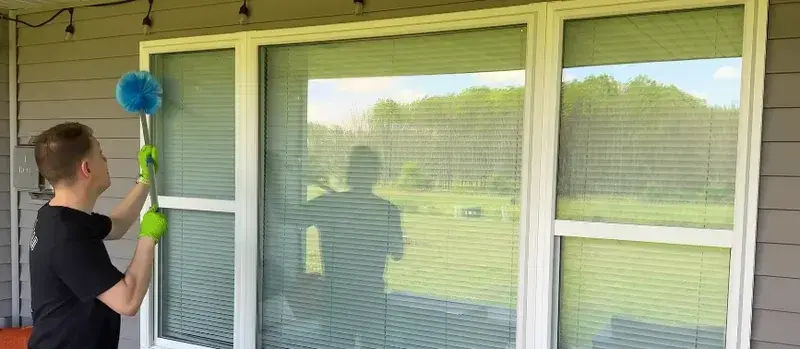
How Sprinklers Cause Hard Water Spots on Windows
Sprinklers can cause hard water spots when irrigation water reaches window glass and dries there. The water evaporates, but dissolved minerals can remain on the surface. When the same pane gets sprayed again and again, those deposits can build up and become harder to remove with routine window cleaning.
The U.S. Geological Survey explains that water hardness is mainly related to dissolved calcium and magnesium. Hard water can leave spots, film, and mineral scale after the water is gone.
This matters around landscaped San Clemente properties because a sprinkler does not have to be broken to put water where it does not belong. Spray radius, sprinkler position, wind, landscaping, and a poorly adjusted arc can all affect where irrigation water lands.
The main idea is simple: The sprinkler does not cause hard water spots simply because it gets the window wet. The problem develops when mineral containing water repeatedly reaches the glass and dries there. And if the sprinkler keeps reaching the pane, removing today’s spots does not remove tomorrow’s water source.
Why Do Sprinklers Leave Hard Water Spots on Windows?
The process starts with the water source.
1. Sprinkler Water Reaches the Glass
Water may reach a window because of sprinkler overspray, spray direction, a wide spray radius, wind, or the layout of the landscaping.
One sprinkler may hit a sliding glass door every watering cycle while another window a few feet away stays dry.
2. Droplets Remain on the Pane
The sprinkler shuts off, but droplets remain on the glass.
Different panes can receive very different amounts of water depending on their height, direction, protection, and distance from the sprinkler.
3. The Water Evaporates
The liquid water begins to dry.
Warm glass and sunlight can change how quickly that happens, but drying does not remove everything that was dissolved in the water.
4. Dissolved Material Can Remain
USGS identifies calcium and magnesium as the main minerals associated with water hardness. When hard water is allowed to evaporate, mineral residue and scale can remain.
Pilkington, a major glass manufacturer, specifically warns that lawn sprinkler systems near buildings can deposit minerals on windows through repeated wetting and evaporation.
5. The Cycle Happens Again
The important part is repetition:
A pane that gets hit during irrigation several times can develop a very different condition from a protected pane on the same property.
Hard water spotting is a repeated water source problem, not simply a dirty window problem.
What Are the White Spots Sprinklers Leave on Glass?
They may be mineral deposits left after irrigation water dries.
Hard water contains dissolved minerals, especially calcium and magnesium. Those minerals do not have to make the water look cloudy while it is spraying. The visible evidence may appear only after the water evaporates.
Pilkington describes dried mineral deposits from sprinkler water as material that can adhere strongly to smooth glass and build up over time.
That is different from ordinary dust or loose dirt sitting on the surface.
Are All White Spots on Windows Hard Water?
No.
White or hazy marks can have other causes, including cleaning residue, runoff, coastal residue, construction material, or changes to the glass surface itself.
A San Clemente address does not make every white mark salt, and a sprinkler near a window does not prove that every mark is a hard water deposit.
White is an appearance. Hard water is a diagnosis.
The water source, location of the marks, exposure pattern, and what remains after routine cleaning provide better evidence.
How Can You Tell If Sprinklers Are Causing the Spots?
Follow the spots back toward the possible water source.
Does the Spotting Match the Sprinkler’s Spray Pattern?
Run the irrigation system and observe where the water actually goes.
Does spray reach the affected pane? Does the wet area line up with the visible spotting? Does the same part of the glass get wet each time?
San Clemente’s own water conservation guidance recommends observing irrigation stations and checking sprinkler height, distance, and spray arc so water lands where intended.
Are Lower Windows More Affected?
Ground level windows, patio doors, and sliding glass doors can sit close to lawn and planter irrigation.
If the bottom portion of a slider facing a lawn is heavily spotted while protected glass higher up remains clearer, a ground level water source is worth investigating.
That pattern is a clue, not proof.
Is One Side of the Home More Spotted?
Compare sprinkler facing panes with protected glass.
Also compare lower windows with upper windows and one side of the property with another.
If only the windows facing an irrigated planter show the same spotting pattern, that relationship deserves attention.
Do the Spots Return in the Same Area?
Recurring marks are especially useful.
If a pane is cleaned and similar spots develop again where irrigation reaches it, the sprinkler remains a plausible source.
The strongest clue is not simply what the spot looks like. It is the relationship between the spot, the pane, and the water source.
Why Do Some Windows Get Sprinkler Spots While Others Stay Clear?
Because exposure is different.
Sprinkler position, spray radius, wind, landscaping, slopes, window height, pane orientation, overhangs, irrigation timing, and nearby barriers can all affect where water lands.
A wall or hedge may protect one pane while another sits directly in the spray path.
Wind can also move fine sprinkler spray beyond the area it normally reaches.
Same property. Same water. Different exposure. Different glass condition.
That is why the condition of one window should not automatically be applied to every pane on the property.
Why Do Hard Water Spots Keep Coming Back After Window Cleaning?
Because cleaning the window and stopping the water source are two different jobs.
If an existing mineral deposit is removed but the sprinkler continues hitting the same pane, another wetting and drying cycle can begin.
New water reaches the glass.
It dries.
New residue may remain.
The process repeats.
Cleaning treats what is already on the pane. Redirecting the sprinkler addresses why new deposits may return.
There is another possibility too. Sometimes homeowners think a mark “came back” when the original persistent condition never completely disappeared.
Ask:
Did new spots form after cleaning, or did the old marks never fully leave?
Those are different problems.
Can Regular Window Cleaning Remove Sprinkler Hard Water Spots?
Sometimes recent or light surface material may improve with cleaning, but established mineral deposits can require a different process from ordinary window cleaning.
Routine cleaning is generally aimed at surface contamination such as dust, loose dirt, fingerprints, and ordinary film.
Pilkington notes that dried sprinkler mineral deposits can adhere strongly to glass and become difficult to remove as buildup increases.
That does not mean every mineral deposit can or should be treated the same way.
Routine window cleaning and hard water restoration are not automatically the same service.
For the treatment focused topic, see Hard Water Stain Removal in San Clemente.
Why Doesn’t Normal Glass Cleaner Remove Sprinkler Spots?
Because the remaining contamination may no longer be ordinary dirt.
A standard window cleaner may remove dust and surface film while leaving a mineral deposit visible underneath.
Applying more of the same cleaner or scrubbing harder does not necessarily solve that problem.
When the contamination changes, the cleaning problem changes.
That is the point where identifying the deposit, glass type, and coating becomes more important than simply applying more force.
Are Sprinkler Spots the Same as Dirt?
No. The source and condition can be different.
| Condition | Typical Source | Routine Cleaning |
|---|---|---|
| Dust | Air and landscaping | Often removable |
| Pollen | Plants and air | Often removable |
| Ordinary film | General exterior exposure | Often removable |
| Sprinkler mineral deposit | Mineral containing irrigation water | May need separate treatment |
| Coastal residue | Coastal environmental exposure | Depends on condition |
| Etching or surface alteration | Change to the glass itself | Cleaning cannot reverse the glass change |
The appearance alone does not always tell you which condition you have.
Are Sprinkler Hard Water Spots the Same as Salt or Coastal Residue?
No.
This distinction matters in San Clemente because coastal exposure and irrigation exposure can exist on the same property.
A pane near North Beach or the Pier Bowl may face marine conditions. A garden facing pane in another part of the property may receive sprinkler overspray. Those are different exposure paths.
Even when two windows both look white or hazy from across the room, they do not automatically have the same material on them.
A sprinkler facing pane should not automatically be diagnosed as coastal buildup simply because the Pacific Ocean is nearby.
For the broader coastal issue, see San Clemente Coastal Window Care Guide.
Are Sprinkler Spots the Same as Rain Spots?
Not automatically.
Rainfall and irrigation water are different water sources.
Rain can move dirt and residue across exterior surfaces. Sprinkler hard water spotting involves irrigation water reaching the pane, drying, and leaving dissolved material behind.
If marks repeatedly line up with sprinkler exposure, investigate that source instead of assuming rain caused them.
When diagnosing a water spot, ask where the water came from before deciding what the deposit is.
See Does Rain Make Windows Dirty? for the separate rain mechanism.
Can Sprinklers Cause Hard Water Spots Even If the Water Looks Clear?
Yes.
Dissolved minerals do not need to make water visibly cloudy.
USGS explains that hard water contains dissolved calcium and magnesium. The water can look clear while those minerals are still present.
You may not notice them until droplets dry and residue becomes visible.
Clear water can still contain dissolved minerals. You may notice the minerals only after the water evaporates.
This is also why spraying a window with apparently clean hose water does not guarantee a spot free result. Andersen specifically cautions homeowners that spraying windows with water can leave mineral spots.
Does Sunlight Cause Sprinkler Hard Water Spots?
No. Sunlight does not create hard water minerals.
Sun and warm glass can affect how quickly a sprinkler droplet dries. The mineral source, however, is the water.
The relationship is:
not:
Sun can change drying speed. It does not create the minerals.
Does the Marine Layer Cause the Same Spots as Sprinklers?
Not automatically.
The marine layer is an atmospheric condition. Sprinkler spotting gives us a specific water source that can be checked at the property.
Marine moisture, coastal aerosol, irrigation water, and rainfall should not all be treated as one contamination mechanism.
Marine layer describes weather around the window. Sprinkler spotting gives us a specific water source relationship to investigate.
See How Marine Layer Affects Windows in San Clemente for the atmospheric side of the issue.
Can Sprinkler Hard Water Spots Permanently Damage Glass?
Persistent mineral deposits and changed glass are not the same condition.
Pilkington’s 2025 sprinkler guidance makes this distinction clearly. It describes the initial mineral buildup as a deposit on the glass rather than automatic staining or etching. It also warns that if heavy deposits remain damp and hold moisture against the glass for long periods, glass staining or etching can become possible.
That does not establish a universal timeline.
It would be inaccurate to say every sprinkler spot becomes etched glass after a set number of weeks or months.
A deposit is material on the glass. Etching is a change to the glass.
If a removable deposit is taken away but a visible surface change remains, routine cleaning alone may not restore the original appearance.
For that diagnosis, see Hard Water Stains vs. Glass Etching.
How Can You Tell Hard Water Deposits From Glass Etching?
Do not diagnose etching simply because a mark looks old or stubborn.
A more useful progression is:
Identify the likely water source.
Look at the deposit pattern.
Remove appropriate surface contamination.
Reassess the clean glass.
Determine what remains.
You cannot reliably diagnose etching simply because the spots have been there a long time.
If the surface condition remains uncertain, further assessment is more useful than repeatedly increasing the strength of the cleaning method.
Why Are Sliding Glass Doors and Lower Windows Often Affected by Sprinklers?
Because landscaping irrigation is often positioned near ground level.
That can place lower windows, patio doors, sliding glass doors, and garden facing glass within the possible spray path.
But height is not the cause.
A low window that never receives irrigation water will not develop sprinkler deposits simply because it is close to the ground.
Height alone does not cause hard water. Exposure to the sprinkler does.
Can Wind Blow Sprinkler Water Onto Windows?
Yes.
A sprinkler does not have to point directly at the house for water to reach glass. Wind can change where smaller droplets travel.
That means actual exposure depends on more than sprinkler direction.
If spotting seems inconsistent, observing the irrigation system under normal operating conditions can reveal where the water is actually going.
How Does Landscaping Affect Sprinkler Spotting on Windows?
Landscaping can change irrigation exposure over time.
Plant growth may affect where water needs to be directed. Sprinkler heads can shift or become damaged. A nozzle can be replaced or adjusted. Soil conditions and slopes can affect irrigation layout. Wind can carry spray beyond the intended planting area.
This helps explain why a homeowner may suddenly notice spots on a window that previously stayed clear.
The City of San Clemente requires irrigation systems covered by its landscape maintenance standards to remain in proper operating condition and specifically identifies overspray and runoff as conditions that should be repaired.
So prevention starts outside the window as much as on the glass.
How Can Irrigation Exposure Affect Windows in Talega and Forster Ranch?
Landscaped residential areas such as Talega and Forster Ranch provide a useful local example of why property level inspection matters.
The neighborhood itself does not cause hard water spots.
What matters is whether irrigation water reaches a particular window and repeatedly dries there.
The same principle applies to landscaped properties in Rancho San Clemente, Marblehead, and elsewhere in San Clemente.
One house may have irrigation safely directed away from the structure. Another may have a sprinkler head that reaches a lower pane or sliding door.
Neighborhood does not cause the spots. The relationship between irrigation and the glass does.
That is more useful than assuming every property in one part of San Clemente has the same water or sprinkler problem.
Can Sprinkler Water Affect Window Screens, Frames and Tracks Too?
Yes. Overspray does not stop at the center of the pane.
Water can reach screen mesh, screen frames, exterior window frames, sills, and nearby track areas.
But those surfaces may be made from different materials and may require different care.
A treatment appropriate for glass is not automatically appropriate for every frame, coating, or screen material.
Andersen, for example, provides separate cleaning guidance for glass, frames, screens, and hardware and warns against harsh abrasives on several window components.
Can Low E or Coated Glass Change How Hard Water Spots Should Be Treated?
Yes.
Before aggressive cleaning, it matters what kind of glass and coating you are dealing with.
The National Glass Association advises identifying whether coated glass surfaces are exposed and following the glass supplier’s specific cleaning instructions. It also warns against abrasive maintenance cleaning and razor blades on coated glass surfaces.
Andersen likewise warns that abrasive or hard objects can damage certain exterior Low E coatings.
The fact that a deposit is mineral based does not give permission to use any chemical or abrasive method on the glass.
Should You Use a Razor Blade on Sprinkler Hard Water Spots?
Do not assume a metal blade is safe simply because the mark is on glass.
Glass products and exposed coatings differ.
Andersen specifically warns against metal razor blades on its Low E4 exterior coated glass because scratching can damage the coating. The National Glass Association also warns against razor blades on coated glass surfaces.
If the glass type is unknown, blindly scraping a stubborn deposit creates an unnecessary risk.
Manufacturer instructions should take priority over generic internet cleaning advice.
Does Vinegar Remove Sprinkler Hard Water Spots?
It can help with some mineral residue, but it is not a universal answer for every window.
USGS explains that the acidity of vinegar can help dissolve mineral particles in hard water deposits. Andersen also lists vinegar among acceptable cleaners for some of its glass products, while giving different instructions for certain special coatings.
That difference matters.
A mild recent deposit and a heavy established buildup may not respond the same way. The glass and coating also need to be considered.
If a DIY attempt is not changing the mark, do not assume the answer is automatically a stronger acid, abrasive pad, or harder scrubbing.
Why Is Scrubbing Harder Not the Answer?
Because a stubborn mark does not automatically mean the glass needs more force.
Abrasive pads, random powders, metal blades, harsh chemicals, or uncontrolled acid products can introduce a new problem while trying to solve the first one.
The National Glass Association warns that architectural glass can be permanently damaged by improper cleaning and recommends following glass manufacturer procedures.
Pilkington also warns that repeated abrasive or strong acid cleaning used to attack sprinkler mineral buildup can ultimately damage glass.
A harder deposit does not automatically call for a harder scrub.
How Do You Stop Sprinklers From Causing New Hard Water Spots?
Keep mineral containing irrigation water from repeatedly reaching the glass.
Start by observing the irrigation system rather than guessing.
Check whether a sprinkler head is spraying too high, too far, or through too wide an arc. Look for damaged or shifted heads. Check whether wind carries the spray toward the house. Recheck the system after landscaping or irrigation work.
San Clemente’s water conservation guidance tells residents to observe irrigation stations, repair broken heads, and adjust sprinkler height, distance, and arc so water lands where intended.
That advice serves two purposes here.
It reduces wasted water and can remove the repeated water source that is reaching the glass.
For broader prevention, see How to Prevent Hard Water Spots on Windows.
Will Hard Water Spots Come Back After Professional Removal?
They can if mineral containing water continues reaching and drying on the same pane.
Successful removal does not make the glass permanently immune to new deposits.
If the sprinkler continues its old spray pattern, a new cycle can begin after the window has been cleaned.
The cleaning result and the recurrence risk are two different questions.
This is why the water source should be part of the conversation whenever spotting repeatedly appears in the same area.
Should You Fix the Sprinkler Before or After Removing the Spots?
Both problems can be addressed without treating them as the same job.
Correcting overspray helps stop new wetting and drying cycles.
Cleaning or mineral treatment addresses what is already on the glass.
If possible, identify the recurring source early so freshly cleaned glass is not immediately exposed to the same sprinkler pattern.
Stopping overspray helps prevent new cycles. Cleaning addresses deposits already present.
What Should You Do If You Notice Sprinkler Spots Early?
Use a simple sequence.
- Check whether irrigation reaches the pane.
- Observe the sprinkler’s actual spray pattern.
- Correct visible overspray where appropriate.
- Let the glass dry and inspect what remains.
- Clean ordinary surface dirt with a method appropriate for the glass.
- Reassess persistent white spots or haze.
- Check manufacturer guidance if the glass or coating is uncertain.
- Seek further assessment rather than escalating blindly if the marks remain.
The goal is to solve both sides of the problem:
When Is Routine Cleaning No Longer Enough?
Pay attention when ordinary dirt is gone but the spots remain.
Other clues include persistent white rings after the glass dries, haze that routine cleaning does not change, recurring marks that match sprinkler exposure, uncertainty about the glass coating, or DIY attempts that are becoming increasingly aggressive.
At that point, another pass with ordinary glass cleaner may not answer the important question.
When routine cleaning stops changing the mark, the next step should be diagnosis rather than more force.
That diagnosis may separate removable mineral buildup from a glass condition that needs different expectations.
How Should Sprinkler Hard Water Spots Be Evaluated in San Clemente?
A useful evaluation follows the evidence from the pane back to its possible source.
Start by identifying the affected windows. Look for nearby irrigation and compare exposed panes with protected ones. Check whether the spot pattern lines up with where sprinkler water can travel.
Then separate ordinary dirt from material that remains after routine cleaning.
The glass type and exposed coating matter before stronger treatment is considered. Access matters too, especially for larger panes or glass above ground level.
Finally, reassess the glass after appropriate surface contamination has been addressed.
If irrigation is visibly reaching the pane, correcting that exposure is part of reducing the chance of recurrence.
No responsible evaluation should promise that every old mineral deposit can be completely removed before the condition of the glass is known.
How Sprinklers Cause Hard Water Spots on Windows FAQs
Why Do Sprinklers Leave White Spots on Windows?
Irrigation water can contain dissolved minerals. When droplets dry on glass, some dissolved material can remain as visible residue.
Are Sprinkler Spots Always Hard Water?
No. Appearance alone is not enough to diagnose a mark. Check the water source, spray pattern, location, and what remains after routine cleaning.
Can Clear Sprinkler Water Still Leave Mineral Spots?
Yes. Dissolved minerals can be present even when the water looks clear. The residue may become visible only after the water evaporates.
Why Do Sprinkler Spots Keep Coming Back?
If the sprinkler continues reaching the same glass, new droplets can dry and leave new deposits after previous spots have been cleaned.
Does Normal Window Cleaning Remove Sprinkler Spots?
It may remove light surface contamination, but established mineral deposits can require a different process from routine window cleaning.
Are Sprinkler Spots the Same as Salt Residue?
No. Sprinkler mineral deposits and coastal residue have different possible sources. A coastal location alone does not identify the material on the pane.
Are Sprinkler Spots the Same as Rain Spots?
Not automatically. Rain and irrigation are different water sources. Repeated spotting that follows a sprinkler’s spray pattern makes irrigation worth investigating.
Does Sunlight Cause Hard Water Spots?
No. Sun can change how quickly water dries, but it does not create the minerals in the water.
Can Sprinkler Hard Water Permanently Damage Glass?
Mineral deposits and glass surface alteration are different conditions. Long standing buildup should not be ignored, but there is no universal timeline after which every sprinkler spot becomes etched glass.
Can I Use Vinegar on Sprinkler Spots?
Vinegar can help dissolve some mineral residue, but the appropriate cleaner depends on the deposit and the glass or coating. Manufacturer guidance should be checked before stronger treatment.
Should I Use a Razor Blade on Hard Water Spots?
Do not assume a metal blade is safe. Some coated glass products can be damaged by blades or abrasive tools.
How Do I Stop Sprinkler Spots From Returning?
Identify and correct the irrigation exposure. Adjusting or repairing the sprinkler so mineral containing water no longer repeatedly reaches the pane addresses the source of new deposits.
Do the Same Spots Keep Returning Near Your Sprinklers?
If white spots or haze keep returning on the same San Clemente windows, look at the water source as well as the glass.
The pattern may help distinguish ordinary dirt from mineral deposits and show whether sprinkler overspray is creating repeated exposure.
Removing the spots and removing the cause are two different jobs. Cleaning addresses the mineral deposit already on the glass. Keeping sprinkler water off the pane addresses why new deposits may return.