
Window Screens and Tracks: Cleaning, Maintenance & Professional Service
Window screens collect dust, pollen, insects and outdoor debris, while window tracks can hold dirt, grit, leaves and other material over time. Cleaning both can improve the finished appearance of the whole window area, but screen washing and detailed track cleaning are different tasks from cleaning the glass.
Light buildup can often be handled with routine maintenance. Heavily soiled screens, packed tracks or damaged components may need more detailed attention or repair rather than basic cleaning.
Clean glass is only one part of the finished window. Screens, tracks, frames and sills can affect how clean the whole window area looks.
Why Do Window Screens Get Dirty?
Window screens sit between indoor space and the outdoors. Their mesh can collect material carried by air, landscaping and normal outdoor activity.
Common buildup includes:
- dust
- pollen
- airborne debris
- outdoor grime
- insects
- cobwebs
- moisture related residue
- material from nearby landscaping
The amount varies from one window to another. A protected screen may stay relatively clean while a more exposed screen collects visible buildup sooner.
How Do Dust and Pollen Build Up on Screens?
Screen mesh contains many small openings and surfaces where fine particles can settle.
A light layer may not look obvious from outside. From indoors, however, sunlight and the view through the screen can make the buildup easier to notice.
What About Outdoor Debris and Insects?
Small insects, cobwebs and pieces of outdoor debris can collect on the mesh or around the screen frame.
Loose material is usually different from staining or physical screen damage, so the condition should be checked before choosing a cleaning method.
Why Can Screens Look Dirtier Than the Glass?
Glass provides a relatively smooth surface. Screen mesh contains many small strands and openings where particles can collect.
That means a dusty screen may remain visibly dull even when the glass behind it has already been cleaned.
How Do Dirty Screens Affect the Appearance of Clean Windows?
Cleaning the pane does not remove dust and pollen from the screen in front of it.
A screen coated with buildup can make the whole window area look less clear, especially when you are looking outside through the mesh.
Can Screens Make a Window Look Hazy?
They can affect how clear the view appears through the window.
Before assuming newly cleaned glass is still hazy, look at whether you are viewing it through a dusty screen. The screen and glass are separate surfaces.
Why Does the Whole Window Area Matter?
A homeowner normally sees more than the pane itself.
The screen, frame, sill and visible track are all part of the finished window area.
A clean pane behind a dirty screen can still look unfinished.
How Do You Clean Window Screens?
For routine screen cleaning, start gently.
Milgard recommends using mild soap, water and a soft brush for its screens, followed by a clear water rinse. Andersen gives similar instructions for its insect screen mesh and frames, using mild soapy water and a soft bristle brush. Both manufacturers emphasize gentle care rather than aggressive cleaning.
A basic process is:
- Inspect the screen and frame for damage.
- Remove loose dust and debris.
- Use a gentle cleaning method appropriate for the screen.
- Rinse or wipe away loosened material as appropriate.
- Allow the screen to dry.
- Reinstall it carefully if it was removed.
Always check the window manufacturer’s care instructions when available because screen materials and removal systems vary.
Should Window Screens Be Removed Before Cleaning?
Sometimes.
Removing a screen can make both sides easier to reach. Milgard’s current care guide instructs owners to carefully remove its screens and place them on a clean, flat surface before washing.
That should not be treated as a universal instruction for every screen.
If a screen does not release normally, do not assume it needs to be pried out. Screen retention systems and window designs vary. Forcing a difficult or fragile screen can damage the mesh, frame or hardware.
What Should You Avoid When Cleaning Screens?
Avoid aggressive pressure, harsh scrubbing, bending the frame or pulling on weakened mesh.
Milgard specifically warns against high pressure washing windows and screens because it may cause damage. Its care instructions also recommend avoiding objects that could puncture or tear screen material.
A screen that already feels brittle, loose or damaged deserves extra care.
What Is the Difference Between a Dirty Screen and a Damaged Screen?
Cleaning and repair solve different problems.
| Condition | Can Routine Cleaning Help? |
|---|---|
| Dusty mesh | Yes |
| Pollen buildup | Yes |
| Light outdoor grime | Yes |
| Insect and loose debris | Yes |
| Torn mesh | No |
| Bent frame | No |
| Loose screen material or spline | No |
| Brittle or deteriorated material | No |
Can Cleaning Repair a Torn or Bent Screen?
No.
Cleaning can remove contamination from a screen. It cannot repair torn mesh, straighten a damaged frame or restore deteriorated screen material.
If the screen is torn, warped, loose or physically damaged, repair or replacement may be the appropriate next step.
Screen cleaning should not be presented as screen repair.
Why Do Window Tracks Get Dirty?
Window and sliding door tracks contain channels, corners and recessed areas where loose material can settle.
Depending on the location and how the opening is used, tracks may collect:
- dust
- soil
- grit
- pollen
- insects
- cobwebs
- leaf fragments
- pet hair
- outdoor debris
- construction dust where applicable
Open windows and doors can also allow material to move into the track area.
Why Do Tracks Hold More Debris Than Glass?
Their shape is different.
Flat glass is relatively easy to wipe across. Tracks contain narrow channels, corners and areas around moving components.
Loose material can settle in those spaces instead of falling away.
What Kind of Dirt Builds Up in Window Tracks?
Fine dust and grit are common, but tracks can also hold dead insects, pollen, soil, cobwebs and small pieces of outdoor debris.
Sliding patio doors may collect additional material because the opening is larger and often used more frequently than a typical window.
Can Track Dirt Become Harder to Remove Over Time?
Yes.
Loose material is usually easier to remove than packed buildup. Repeated use can move debris into corners and recessed areas, while moisture can combine with dust and soil to create more stubborn grime.
That does not mean every dirty track needs deep detailing.
The condition determines the work.
How Do You Clean Window Tracks?
Start with dry, loose debris before adding moisture.
Milgard advises periodically vacuuming sliding window and patio door tracks to remove dirt and debris. Its maintenance guidance also recommends wiping tracks and sills with a damp cloth or using a vacuum for dust and dirt.
A practical sequence is:
- Open the window and inspect the track.
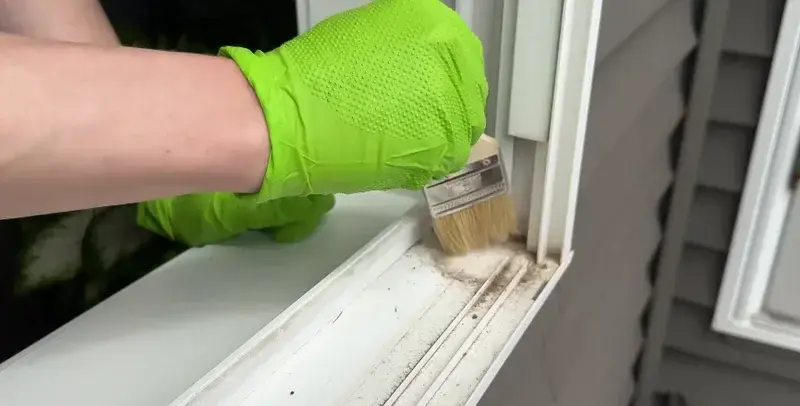
- Vacuum or brush out loose material.
- Use a suitable small brush or detailing tool for accessible corners.
- Wipe remaining grime from appropriate surfaces.
- Check recessed areas for material that was missed.
- Inspect drainage openings if the window has a weep system.
- Wipe or dry the area as appropriate.
Why Should Loose Debris Come Out First?
Removing dry grit, insects and other loose material first keeps you from simply spreading it through the track with a wet cloth.
It also lets you see what buildup remains and whether deeper cleaning is actually needed.
Why Can Detailed Track Cleaning Take Longer?
A lightly dusty track and a track packed with old debris are different jobs.
Routine track maintenance may involve vacuuming loose material and wiping accessible surfaces.
Detailed cleaning may require more time in corners, channels and recessed areas.
This distinction is important when comparing professional window cleaning scopes.
What About Window Weep Holes and Drainage Openings?
Some windows and patio doors use weep systems to drain water to the exterior.
Milgard explains that its windows and patio doors have exterior weep drainage openings and advises keeping the sill or track clear of debris. It also recommends periodically checking the exterior weep holes and using a soft brush to clear debris when needed.
Why Do Weep Holes Need to Stay Clear?
On a window designed with a weep drainage system, the openings provide a path for accumulated water to move outside.
Dirt and debris can obstruct that path.
This makes track maintenance more than a cosmetic issue on those specific window systems.
Does Every Window Have the Same Drainage Design?
No.
Do not assume every opening, slot or channel should be cleaned, enlarged or altered.
Follow the manufacturer’s instructions for your window or door. If a drainage problem continues after accessible debris has been cleared, the issue may need assessment rather than more cleaning.
What About Window Frames and Sills?
Frames and sills can collect dust, pollen, outdoor debris, grime and water residue.
They are separate components and should be treated according to their material, finish and condition.
How Should Window Frames Be Cleaned?
Manufacturer instructions matter.
For its window and door frames, Milgard recommends mild, nonabrasive soap and water and warns against abrasive or acidic cleaners that could damage the finish.
That does not mean one cleaner is suitable for every frame material or coating.
If you know the window manufacturer, follow its care instructions before using stronger chemicals or abrasive tools.
Why Do Sills Matter?
Sills can collect dust, outdoor debris and water residue around the window area.
Even when the pane is clean, visible dirt along the sill can make the overall job look incomplete.
Why Do Frames and Sills Matter to the Finished Look?
Because the eye sees the whole window area.
Clean glass beside a dusty frame, dirty sill or debris filled track does not have the same finished appearance as a window where the agreed surrounding components have also been detailed.
How Do Tracks Affect Overall Window Detailing?
Glass cleaning and complete window detailing are not automatically the same service.
Cleaning the glass addresses the pane. Track detailing addresses material collected in the channels and recessed areas around the moving window or door.
What Is Light Track Cleaning?
Light track cleaning may include vacuuming or removing loose debris and wiping accessible surfaces.
For a regularly maintained window, that may be enough.
What Is Detailed Track Cleaning?
Detailed track cleaning deals with heavier buildup in corners, channels and recessed areas.
It can require more manual work than a quick vacuum or wipe.
Light track cleaning and detailed track cleaning should not be treated as identical scopes.
How Often Should Window Screens Be Cleaned?
There is no useful universal schedule for every home.
Screens should be cleaned based on visible buildup, exposure and how quickly they collect dust, pollen and outdoor debris.
Factors include:
- outdoor exposure
- landscaping
- pollen
- coastal conditions
- how often windows are opened
- pets
- the condition of the screen
Manufacturer recommendations can provide another reference point. Andersen recommends cleaning its insect screen mesh and frame at least annually, with cleaning at least every three months in coastal, industrial or agricultural areas with higher airborne dirt, dust, smoke or salt spray.
That is Andersen product care guidance, not a universal schedule for every San Clemente screen.
Should Screens Be Cleaned Every Time the Glass Is Cleaned?
Not necessarily.
If a screen remains relatively clean, it may not require the same level of washing at every glass cleaning.
If the mesh is visibly dusty or coated with outdoor buildup, cleaning it at the same visit may produce a more complete finished appearance.
Screen frequency should follow condition, not habit.
How Often Should Window Tracks Be Cleaned?
Track maintenance should also follow use and condition.
A window that is rarely opened and remains protected may collect debris slowly. A frequently used sliding door can accumulate material much faster.
Look at:
- how often the window or door is opened
- visible debris
- dust and grit
- insects
- pets
- landscaping
- exterior exposure
Do Sliding Patio Doors Need More Track Attention?
They can.
Their larger openings and frequent use can expose the track to more dirt and debris, depending on the property.
That does not mean every sliding door needs deep cleaning on a fixed schedule.
Do Tracks Need Deep Cleaning Every Time?
No.
Routine loose debris removal may be enough until more substantial buildup develops.
For a broader home window maintenance schedule, see How Often Should You Clean Your Windows in San Clemente?
Does San Clemente’s Coastal Exposure Affect Screens and Tracks?
It can, but exposure varies across San Clemente.
Screens and exterior window components can encounter dust, wind driven material and coastal related residue. Manufacturer guidance also shows that coastal conditions can affect maintenance needs for some window and screen products.
Andersen specifically recommends more frequent cleaning of its insect screens in coastal areas with higher airborne dirt, dust and salt spray. Milgard also calls for more frequent hardware maintenance in high salt air environments. These manufacturer recommendations show that coastal exposure can change maintenance needs, but they do not establish one cleaning schedule for every San Clemente home.
A directly exposed opening near the coast may behave differently from a protected window farther inland in Forster Ranch or Talega. Building orientation, wind exposure, landscaping and how often the window is open all matter.
Do Screens Catch Outdoor Material Before It Reaches the Glass?
Screens can collect airborne material on their mesh because they sit outside or alongside the glass.
They should not be described as a complete filter. Fine particles and other contamination can still reach the glass and surrounding components.
Do Coastal Homes Need a Fixed Screen Cleaning Schedule?
No.
Manufacturer guidance shows that coastal exposure can justify more frequent inspection and cleaning for some products, but the useful interval for an individual San Clemente home should still follow actual exposure, manufacturer guidance and condition.
See our San Clemente Coastal Window Care Guide for more about coastal glass and exterior window maintenance.
Can Dirty Screens Make Windows Dirty Again Faster?
Possibly, depending on conditions, but this should not be overstated.
A dirty screen can hold dust and debris close to the glass. Wind, moisture and opening or closing the window can move some material around the window area.
What we can say with confidence is simpler:
Dirty screens can reduce the finished appearance of otherwise clean windows.
Cleaning a pane does not remove the material still sitting on the screen in front of it.
What Does Routine Professional Screen and Track Cleaning Include?
There is no universal professional scope.
Depending on the company and the agreed service, routine work may include:
- basic screen cleaning
- removal of loose screen debris
- accessible track cleaning
- frame or sill wiping
- screen removal and reinstallation where appropriate
- a final visual check
Exact scope should be confirmed before service.
Do not assume that a quote for window cleaning automatically includes deep track detailing or screen washing.
Is Routine Cleaning the Same as Restoration or Repair?
No.
Routine cleaning does not automatically include:
- screen repair
- frame repair
- track repair
- roller or hardware repair
- corrosion repair
- replacement parts
- deep restoration
If a component is physically damaged, cleaning may improve its appearance without correcting the defect.
When Might Detailed Screen or Track Cleaning Be an Extra Scope?
More detailed work may be needed when there are:
- heavily packed tracks
- long neglected debris
- sticky residue
- unusual buildup
- many screens
- difficult screen removal and reinstallation
- specialty screen or frame systems
- additional detailing requests
Why Can Detailed Track Cleaning Be Quoted Separately?
Because it can require more time, tools and manual detailing than ordinary glass cleaning or a light track wipe.
This is why the phrase “tracks included” is not always enough information when comparing window cleaning quotes.
Ask what level of track cleaning is actually included.
Is DIY or Professional Screen and Track Cleaning Better?
Both can make sense.
| Factor | DIY | Professional Service |
|---|---|---|
| Light screen dust | Often practical | Easy to include when agreed |
| A few accessible screens | Practical | Convenient |
| Heavy screen buildup | More time consuming | Detailed service may help |
| Light track debris | Usually manageable | Routine service |
| Packed tracks | More effort | Detailed cleaning may help |
| High windows | Access concern | Better professional fit |
| Damaged screen | Cleaning will not repair it | Repair specialist may be needed |
| Many windows and screens | Time intensive | Often more practical professionally |
When Does DIY Make Sense?
DIY cleaning can be reasonable when you have a few accessible screens, light buildup, simple tracks and no damaged components.
Use gentle methods and follow the manufacturer’s instructions when available.
When Does Professional Service Make More Sense?
Professional cleaning may make more sense when there are many windows, substantial buildup, difficult access, second story openings or a combined glass, screen and track scope.
High access changes the safety question as well as the cleaning question.
See Professional Window Cleaning vs DIY and Second Story and Hard to Reach Window Cleaning for those decisions.
How Do Professionals Clean Screens and Tracks?
The method depends on the component and its condition.
Possible tools include soft brushes, microfiber or other detailing materials, vacuums for loose debris, screen cleaning equipment and track detailing tools.
A professional may also use controlled rinsing or other cleaning methods appropriate for the screen or surrounding surface.
Why Does the Condition Change the Method?
A sturdy screen with ordinary dust should not automatically be treated the same way as fragile mesh in a bent frame.
The same applies to tracks.
Light dust is different from packed debris.
The first step is understanding what is dirty, what is damaged and what the agreed service actually covers.
For more about professional equipment and method selection, see Professional Window Cleaning Tools, Water & Methods.
What Should You Ask Before Booking Screen and Track Cleaning?
Ask what the quote actually includes.
Useful questions are:
- Are the screens cleaned?
- Is screen removal and reinstallation included?
- Are the tracks included?
- Does “track cleaning” mean a light wipe or detailed cleaning?
- Are frames and sills included?
- Is deep detailing an extra service?
- Are high or second story screens included?
- Does the company repair damaged screens, or only clean them?
This prevents a common scope misunderstanding.
“Window cleaning” does not automatically mean every surrounding component is included. Confirm the agreed scope before work begins.
When Is Cleaning Not Enough?
Cleaning has limits.
It cannot repair:
- torn screen mesh
- bent screen frames
- broken hardware
- damaged tracks
- cracked components
- failed rollers or window mechanisms
Can Cleaning Fix a Window That Is Hard to Open?
Sometimes debris may contribute to poor movement, so cleaning an obviously dirty track can help where dirt is the cause.
But a window that remains difficult to operate after accessible debris has been removed may have a mechanical, alignment, roller, hardware or other component problem.
More cleaning is not a substitute for repair.
When Might a Repair Specialist Be Needed?
If the problem is structural or mechanical rather than contamination, a window, door or screen repair specialist may be the appropriate next step.
A professional cleaner should distinguish between something that needs to be cleaned and something that needs to be repaired or replaced.
Window Screen and Track Cleaning Checklist
Use the visible condition to decide the next step.
| What You See | Likely Next Step |
|---|---|
| Light dust on screens | Routine cleaning |
| Pollen buildup | Screen cleaning |
| Insects or loose debris in tracks | Loose debris removal |
| Heavy packed track dirt | Detailed track cleaning |
| Dusty frames or sills | Routine detailing |
| Torn screen | Repair or replacement, not cleaning |
| Bent screen frame | Repair or replacement |
| High or second story screens | Access planning |
| Dirty screens and glass | Combined cleaning scope |
| Persistent mechanical problem | Assessment or repair |
Window Screen and Track Cleaning FAQs
How often should window screens be cleaned?
Clean screens according to visible buildup, outdoor exposure and the manufacturer’s care instructions. Some manufacturer guidance recommends more frequent cleaning in coastal environments, but there is no universal schedule for every home.
How often should window tracks be cleaned?
Clean tracks when dust, grit, insects or other debris begins to accumulate. Frequently used sliding doors may need attention sooner than protected windows that are rarely opened.
Should window screens be cleaned every time the glass is cleaned?
Not necessarily. Screen cleaning should follow the screen’s condition. If it is visibly dusty when the glass is being cleaned, including it can produce a more complete finished appearance.
Can dirty screens make clean windows look dirty?
Yes. Dust and pollen on the mesh can make the overall window area look dull even when the pane behind it is clean.
What is the easiest way to clean window tracks?
Start by vacuuming or brushing out loose debris. Then clean accessible track surfaces with a method appropriate for the window material and manufacturer instructions.
Can professional window cleaners clean tracks?
Yes, depending on the agreed scope. The level of cleaning varies, so confirm whether the quote includes light track cleaning or detailed track work.
Is deep track cleaning always included with window cleaning?
No. Detailed cleaning of packed or neglected tracks may be a separate scope because it can require more time and manual work.
Can professional cleaning fix torn screens?
No. Cleaning removes dirt and debris. Torn mesh, bent frames and other physical damage require repair or replacement.
Do frames and sills need cleaning too?
They can collect dust, grime and outdoor debris. Cleaning them can improve the finished appearance of the overall window area when they are included in the service scope.
Should Screens Be Cleaned Before or After the Glass?
The exact workflow can vary with the window and cleaning method. What matters is controlling dirt and water so completed glass or surrounding surfaces are not unnecessarily soiled again.
Need Your Glass, Screens and Tracks Cleaned?
If your San Clemente windows have dusty screens, debris in the tracks or surrounding window areas that need attention, the first step is defining what actually needs cleaning.
Window Specialists San Clemente can discuss the glass, screens, tracks, frames and sills that are part of your requested scope and whether routine or more detailed cleaning is appropriate.
Monday through Saturday, 8:00 AM to 6:00 PM
Updated September 2026