
How Professional Window Cleaning Works: Tools, Water & Methods
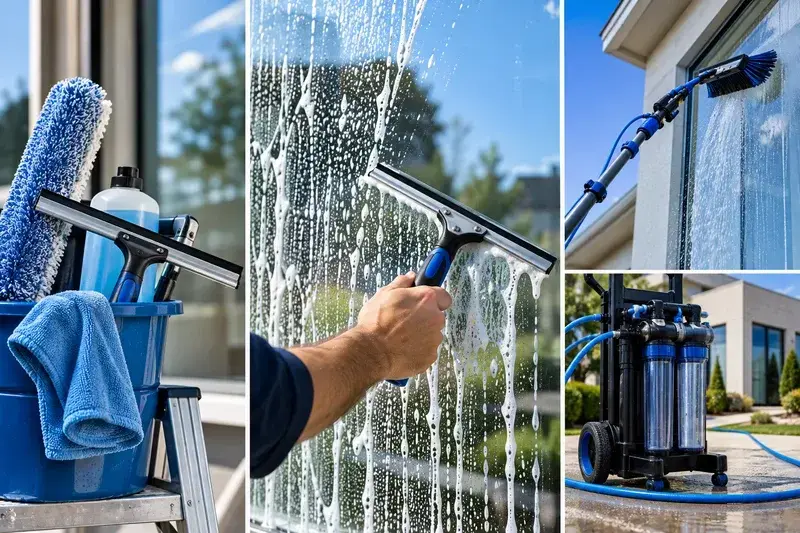
Professional window cleaning is not one fixed technique. Cleaners choose tools and methods based on whether the glass is inside or outside, its condition, the type of buildup, its height, and how it can be reached safely. Common tools include window washers, squeegees, microfiber towels, extension poles, water fed poles, and purified water systems. Ordinary dirt may need routine cleaning, while mineral deposits or construction residue can require a different approach.
What Does a Professional Window Cleaning Process Usually Involve?
Professional window cleaning starts before a tool touches the glass.
A cleaner first needs to understand the window, what is on it, and the surrounding working conditions. Ordinary dust, mineral deposits, construction residue, scratches, and fog between panes are not the same problem.
Step 1: Assess the Window and Surroundings
The initial assessment may consider:
- Interior or exterior location
- Height and access
- Glass type and condition
- Type of buildup
- Screens and tracks
- Frames and surrounding finishes
- Nearby furniture or landscaping
- Unusual stains or residue
The National Glass Association recommends identifying exposed coated surfaces and following appropriate glass cleaning guidance because improper cleaning can permanently damage architectural glass.
Step 2: Choose the Appropriate Cleaning Method
Method selection should follow the actual condition.
An accessible interior pane with fingerprints may be suited to a washer, squeegee, and detailing cloth. Suitable exterior glass may be cleaned with a traditional method or a purified water system.
Specialty contamination may require a different approach.
Step 3: Protect the Property
Professional cleaning also means controlling water, tools, and access around the glass.
Inside, this can involve floors, furniture, walls, window coverings, and personal items. Outside, landscaping, doors, frames, finished surfaces, and areas used by occupants may need consideration.
Step 4: Clean the Glass
The selected method is used to loosen ordinary contamination such as dust, pollen, fingerprints, and surface grime.
Step 5: Remove or Rinse Away the Dirty Solution
Traditional cleaning commonly removes dirty solution with a squeegee.
A suitable purified water method uses physical agitation followed by a thorough rinse with purified water.
These methods work differently, but both depend on removing contamination from the glass rather than simply making it wet.
Step 6: Detail the Window
Remaining moisture around edges and corners can be addressed where needed.
Step 7: Inspect the Result
The final inspection may reveal:
- Missed contamination
- Streaks or residue
- Mineral deposits
- Scratches
- Fog between panes
- Another glass condition
A mark that remains after routine cleaning does not automatically mean the glass needs another cleaning pass.
What Tools Do Professional Window Cleaners Use?
Professional window cleaners use different tools for different jobs.
| Tool or System | Typical Role |
|---|---|
| Window washer or scrubber | Loosens ordinary dirt and surface contamination |
| Squeegee | Removes dirty cleaning solution from glass |
| Microfiber or detailing towels | Edges, corners and touch ups |
| Extension poles | Extend the reach of cleaning tools |
| Water fed poles | Scrub and rinse suitable exterior glass from extended reach |
| Purified water system | Supplies treated water for suitable exterior cleaning methods |
| Ladders or access equipment | Provides access where appropriate |
| Specialty tools or products | Used when the condition falls outside routine cleaning |
The important question is not simply which tools a cleaner owns.
The important question is why a particular tool fits a particular window.
What Is a Window Washer or Scrubber Used For?
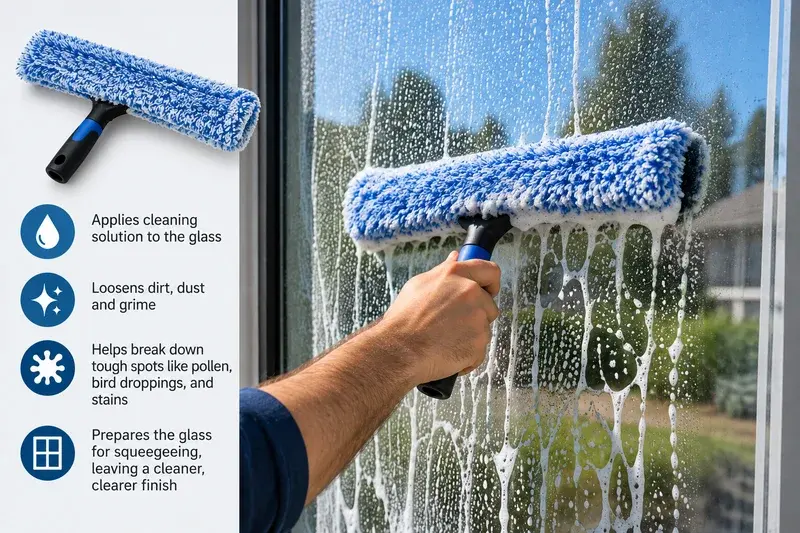
A window washer or scrubber wets the glass and helps loosen surface contamination.
It may be used on:
- Dust
- Fingerprints
- Pollen
- Ordinary grime
- Light surface film
The cleaning action loosens contamination before the dirty liquid is removed.
Why Is the Glass Usually Washed Before It Is Detailed?
Detailing is mainly finishing work.
A microfiber towel around the edges cannot replace proper cleaning of a dirty main glass surface. The contamination first needs to be loosened and removed.
Why Do Loose Grit and Debris Matter?
Loose particles deserve attention before the glass is rubbed.
The National Glass Association warns that improper cleaning can damage architectural glass. Unusual debris should not simply be rubbed across the surface without considering the glass and contamination first.
How Does a Squeegee Clean Windows?
A squeegee does not do all of the cleaning by itself.
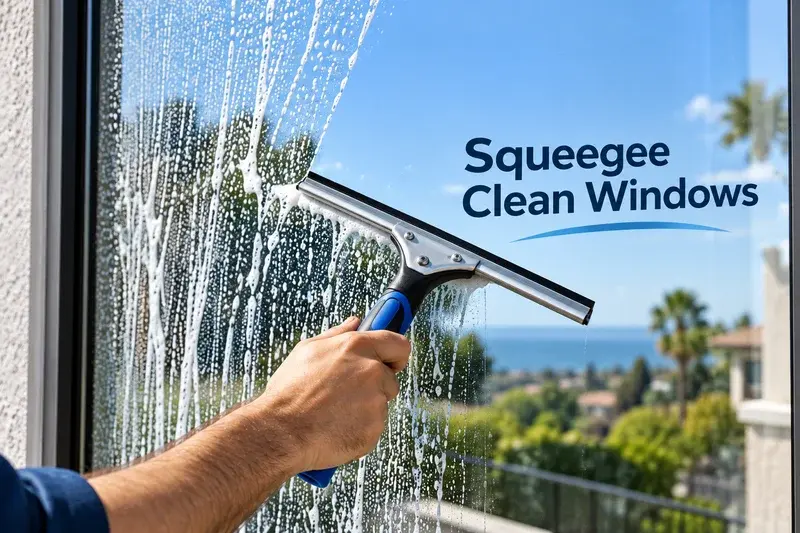
The washing process loosens ordinary contamination. The squeegee then removes the dirty water and cleaning solution from the glass in a controlled way.
Traditional washer and squeegee cleaning remains an established professional method.
Why Does Squeegee Technique Matter?
The result can depend on:
- A clean working edge
- Controlled contact with the glass
- Complete solution removal
- Avoiding redistribution of dirty water
- Final edge detailing
A dirty or damaged squeegee edge can leave lines even when the cleaning solution is appropriate.
Does a Squeegee Guarantee Streak Free Glass?
No.
Results also depend on glass condition, cleaning solution, tool cleanliness, technique, and detailing.
Sometimes the visible mark is not a streak at all. Mineral deposits or scratches can remain after ordinary dirt has been removed.
For more detail, see How to Clean Windows Without Streaks.
What Are Microfiber and Detail Towels Used For?
Microfiber and other suitable detailing materials are commonly used for smaller finishing tasks.
Typical uses include:
- Edge detailing
- Corners
- Small drips
- Fingerprints
- Final touch ups
They support the main cleaning process rather than replace it.
Why Does Clean, Dry Detailing Material Matter?
A dirty or saturated towel can move moisture and residue back across clean glass.
When detailing material starts leaving marks instead of removing them, a cleaner can switch to a clean and drier surface.
What Are Extension Poles Used For?
Extension poles allow suitable cleaning tools to reach beyond normal arm height.
They may be useful for higher windows, recessed glass, difficult exterior locations, and some high interior windows.
An extension pole and a water fed pole are not the same thing.
What Is the Difference Between an Extension Pole and a Water Fed Pole?
An extension pole extends the reach of a tool.
A water fed pole extends reach and carries water through the pole to the cleaning head.
That difference changes how the window can be cleaned.
What Is a Water Fed Pole System?
A water fed pole carries water through an extendable pole to a brush or cleaning head.
On suitable exterior glass, the brush physically agitates contamination while water flows to the surface. The glass is then thoroughly rinsed.
The International Window Cleaning Association recognizes purified water with water fed poles as a professional window cleaning method.
The process can be understood as:
When Are Water Fed Poles Useful?
Depending on the property and glass condition, they may be useful for:
- Exterior windows
- Second story windows
- Hard to reach exterior glass
- Routine surface contamination
- Suitable window surfaces
For certain elevated exterior windows, an extended pole can reduce the need to place a ladder directly at every pane.
That does not remove the need to assess access and other hazards.
Are Water Fed Poles Right for Every Window?
No.
Suitability depends on the glass condition, type of buildup, access, window design, surrounding surfaces, and cleaning objective.
A water fed pole may solve a reach problem without solving a glass condition problem.
For more on access, see Second Story and Hard to Reach Window Cleaning.
What Is Purified Water in Window Cleaning?
Purified water has had dissolved material reduced through a treatment process.
Professional systems may use reverse osmosis, deionization, filtration, or a combination of treatment stages.
For suitable exterior cleaning, purified water can be delivered through a water fed pole. The brush agitates the surface, and the glass is thoroughly rinsed with treated water.
Unlike traditional squeegee cleaning, the final purified rinse can be left to air dry when the system and cleaning process are working correctly.
Why Can Ordinary Tap Water Leave Spots?
Water can contain dissolved minerals and other material.
When mineral containing water dries on glass, some of that dissolved material can remain on the surface.
San Clemente publishes annual water quality reports, and local water conditions and sources can vary by area and over time.
For window cleaning, the useful distinction is simple:
Ordinary tap water and professionally purified cleaning water are not necessarily the same water condition.
Does Purified Water Mean Every Window Dries Perfectly Without Spots?
No.
Purified water is only one part of the process.
Results also depend on proper agitation and rinsing, the condition of the glass, existing contamination, and material that may wash down from surrounding window surfaces.
Pure water is a cleaning method component, not a universal answer to every glass condition.
What Does Deionized Water Mean?
Deionized water is water that has had charged ions removed through an ion exchange process.
In professional window cleaning, deionization can be one part of a purified water system used for suitable exterior glass.
The distinction is:
Purified water is the broader category. Deionization is one way of treating water.
Reverse osmosis may also be part of a professional purification system.
Is Deionized Water the Only Way to Clean Windows Professionally?
No.
Traditional washer and squeegee cleaning remains a professional method. Purified water cleaning is another option.
The right choice depends on the window and cleaning objective rather than which method sounds more advanced.
How Are Interior Windows Cleaned Professionally?
Interior cleaning usually requires tighter control of water and tools because the work takes place around finished living or working spaces.
A traditional process may use a washer, squeegee, and microfiber detailing materials.
The cleaner also needs to consider flooring, furniture, window coverings, walls, trim, electronics, personal items, and available working space.
The goal is not simply clean glass. The cleaning process should also account for the surrounding property.
How Are Exterior Windows Cleaned Professionally?
Exterior cleaning can involve more variables because glass is exposed to weather, landscaping, irrigation, height, screens, frames, and outdoor contamination.
Depending on the window, suitable methods may include:
- Traditional washer and squeegee cleaning
- Extension pole cleaning
- Water fed pole cleaning
- Purified water systems
- Appropriate direct access methods
Is Exterior Dirt Always the Same Type of Dirt?
No.
Exterior glass can carry dust, pollen, insect debris, ordinary grime, mineral deposits, coastal surface residue, or construction related contamination.
That distinction matters in San Clemente.
Homes closer to North Beach or the Pier area may face different coastal exposure from a more protected property. In Talega or Forster Ranch, individual windows may also be affected by irrigation depending on the property layout.
The neighborhood itself does not determine the cleaning method. The actual glass condition does.
For more on local exterior exposure, see our San Clemente Coastal Window Care Guide.
Why Isn’t Every Window Cleaned the Same Way?
Professional window cleaning is a method selection problem before it is a tool selection problem.
Several factors can change the approach.
1. Glass Type
Different glass surfaces and exposed coatings may have different care requirements.
2. Glass Condition
Ordinary dirty glass is different from scratched, etched, fogged, or construction affected glass.
Cleaning should respond to the actual condition rather than assume every visible mark is dirt.
3. Type of Buildup
Ordinary dirt is not the same as mineral deposits.
Mineral deposits are not the same as paint, adhesive, or other construction residue.
The cleaner first needs to understand what is being removed.
4. Height and Access
A ground level window and a second story window may have the same surface dirt but require different tools because access is different.
Fences, landscaping, balconies, narrow side yards, and sloped ground can also affect the approach.
5. Interior or Exterior Location
Interior cleaning requires tighter water control and consideration of nearby belongings and finishes.
Exterior cleaning presents different environmental and access conditions.
6. Cleaning Scope
The service may involve glass only or may also include screens, tracks, frames, sills, or sliding glass doors.
The scope should be confirmed rather than assumed.
The correct method is the one that fits the glass, condition, access and cleaning objective, not simply the most powerful tool available.
How Does Glass Type and Condition Affect the Cleaning Method?
The same product or tool should not automatically be used on every glass surface.
Method selection may be affected by:
- Exposed coatings
- Window film
- Specialty glass
- Existing scratches
- Mineral buildup
- Etching
- Construction residue
- Unknown previous treatments
NGA guidance warns that improper cleaning can permanently damage architectural glass and calls for special care with coated surfaces.
Why Should Glass Condition Be Checked Before Stronger Treatment?
Because stronger cleaning is not automatically better cleaning.
If the visible problem is scratching, etching, coating sensitivity, or another physical condition, more aggressive cleaning may not solve it.
Cleaning removes appropriate contamination. It does not automatically repair the glass itself.
For the difference between deposits and surface alteration, see Hard Water Stains vs Glass Etching.
How Does the Type of Buildup Change the Method?
Different conditions can point toward different cleaning directions.
| Condition | Typical Cleaning Direction |
|---|---|
| Dust and fingerprints | Routine cleaning |
| Pollen and ordinary exterior grime | Routine exterior cleaning |
| Light surface film | Standard cleaning method |
| Mineral deposits | Separate hard water treatment may be needed |
| Construction contamination | Condition specific assessment |
| Scratches or etching | Cleaning cannot repair physical damage |
| Fog between panes | Not a surface cleaning issue |
This is why identifying the condition should come before selecting a stronger product or tool.
What About Hard Water Deposits?
Routine cleaning removes ordinary surface contamination. Established mineral deposits may require separate hard water treatment.
A washer and squeegee can remove ordinary dirt around a mineral spot without removing the deposit itself.
For that specific problem, see How to Remove Hard Water Spots From Windows or Hard Water Stain Removal San Clemente.
What About Post Construction Residue?
Construction contamination is not the same as routine dirt.
The material, glass type, coating, and existing condition should be considered before stronger removal methods are used. Aggressive scraping should not be treated as a universal routine cleaning step.
See Post Construction Window Cleaning San Clemente for the dedicated service information.
How Does Height and Access Affect Window Cleaning Methods?
The same contamination on two windows may require different tools because one pane is harder to reach.
A window may be at ground level, on a second story, above landscaping, behind a fence, beside sloped ground, in a narrow side yard, or high inside a room.
Why Are Reach and Cleaning Method Separate Decisions?
A tool can solve the access problem without solving the glass condition problem.
For example, a suitable pole system may provide access to high exterior glass with routine dirt.
If the same high pane has established mineral buildup, there are two separate questions:
- How can the glass be reached?
- What treatment is appropriate for the deposit?
For more detail, see Second Story and Hard to Reach Window Cleaning.
Are Screens, Tracks, Frames and Sills Part of Professional Window Cleaning?
They can be, but they should not automatically be assumed to be part of every service.
Screens, tracks, frames, and sills may require different tools and different amounts of work. Light cleaning and detailed cleaning can also mean different things.
The service scope should establish what is included before the work begins.
For more information, see our Window Screen and Track Cleaning Guide.
How Do Professional Window Cleaners Approach Safety?
Safety starts before the glass is cleaned.
Professional planning may consider height, access, sloped or uneven ground, wet surfaces, electrical hazards, interior obstacles, equipment handling, and the surrounding work area.
OSHA and the International Window Cleaning Association have developed safety resources specifically for professional window cleaning, including water fed pole work.
Using an extended pole can change how a window is accessed, but it does not make hazard assessment unnecessary.
Method selection is partly a cleaning decision and partly a safety decision.
Detailed access decisions are covered in our Second Story and Hard to Reach Window Cleaning guide.
Professional Window Cleaning Method Selection: Quick Guide
| Situation | Likely Method Considerations |
|---|---|
| Ground level interior glass | Washer, squeegee and detailing |
| Ground level exterior glass | Traditional or suitable purified water method |
| Second story exterior glass | Pole based or appropriate access method |
| High interior glass | Extended reach or direct access planning |
| Ordinary surface dirt | Routine window cleaning |
| Hard water spots | Mineral treatment assessment |
| Construction residue | Condition specific assessment |
| Coated or specialty glass | Surface and manufacturer considerations |
| Screens and tracks | Confirm service scope and appropriate tools |
| Scratches or etching | Cleaning cannot repair physical damage |
| Fog between panes | Not a surface cleaning issue |
Professional method selection can be summarized as:
The method follows the window, not the other way around.
Professional Window Cleaning FAQs
What Tools Do Professional Window Cleaners Use?
Common tools include window washers, squeegees, microfiber detailing cloths, extension poles, water fed poles, and purified water systems. The tools used on a particular job depend on the glass, contamination, access, and cleaning scope.
Why Do Professional Window Cleaners Use Squeegees?
Washing loosens ordinary contamination from the glass. A squeegee then provides controlled removal of the dirty water and cleaning solution carrying that contamination.
What Is a Water Fed Pole?
A water fed pole is an extendable pole that carries water to a brush or cleaning head. On suitable exterior glass, it allows the surface to be scrubbed and rinsed from extended reach.
Why Is Purified Water Used for Window Cleaning?
Purification reduces dissolved material in the cleaning water. In suitable exterior methods, purified water can provide the final rinse after the glass has been properly agitated and cleaned.
Is Deionized Water the Same as Purified Water?
Not exactly. Purified water is the broader term. Deionization is one treatment process that removes charged ions and may be used as part of a professional water purification system.
Are Water Fed Poles Better Than Squeegees?
Not universally.
Both can be appropriate professional methods. The better choice depends on whether the glass is inside or outside, its condition, the type of buildup, access, and the cleaning objective.
Need Professional Window Cleaning in San Clemente?
If you are dealing with routine glass cleaning, hard to reach windows, mineral buildup, or another condition you are unsure how to approach, Window Specialists San Clemente can determine an appropriate cleaning scope and method for your property.
Call (949) 883 0300 to discuss your windows and get a quote based on your property.
Window Specialists San Clemente
San Clemente, CA 92673
8:00 AM to 6:00 PM