
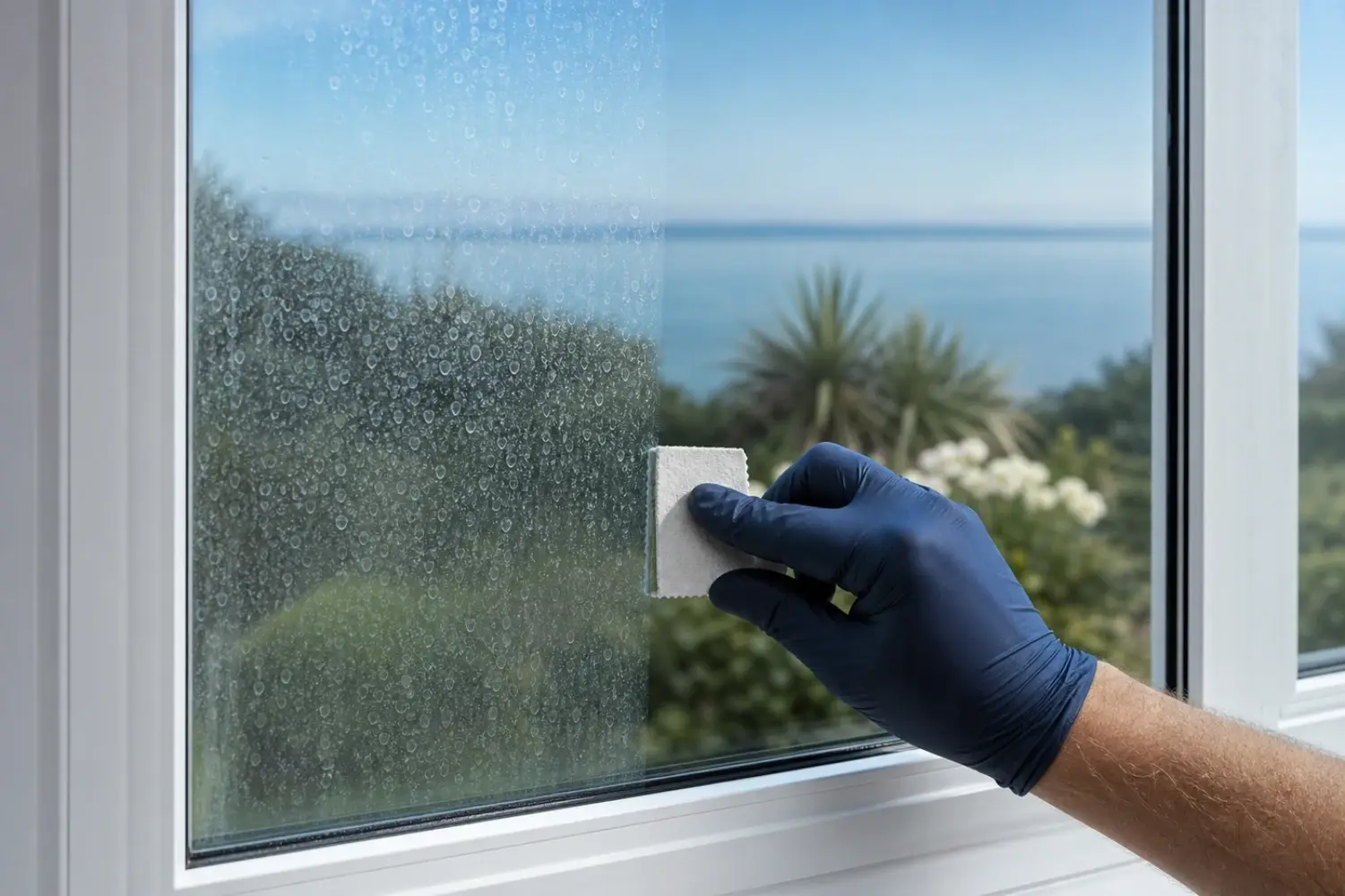
How to Prevent Hard Water Spots From Returning on Windows
The most effective way to reduce recurring hard water spots is to address the water repeatedly reaching the glass, often from sprinkler or irrigation overspray, and maintain exposed windows before mineral deposits become heavily established again.
Cleaning or hard water treatment removes existing deposits. It does not stop the source of mineral containing water. After treatment, reduce repeated wetting where practical, maintain affected glass, and watch for new spotting.
Find the Source → Reduce Exposure → Maintain → Monitor → Reassess
Why Do Hard Water Spots Keep Coming Back?
Hard water spots can return when mineral containing water continues to reach the glass after it has been cleaned or treated.
The basic cycle is:
Water reaches glass → Water dries → Water evaporates → Minerals remain → Exposure repeats → Deposits accumulate
A clean pane can therefore develop new spots if the original water exposure has not changed.
Why Doesn’t Removing the Spots Remove the Problem?
Hard water removal and hard water prevention solve two different problems.
Hard water removal treats existing buildup. Prevention addresses the conditions that allow new buildup to form.
If a sprinkler continues to wet the glass after mineral deposits have been removed, new droplets can dry and leave new residue.
This is why repeatedly treating the same window without checking the water source may only address the result.
How Does Sprinkler Overspray Cause New Mineral Spots?
Sprinkler exposure can create a repeating cycle.
- Sprinkler water reaches the glass.
- Droplets remain on the surface.
- Water evaporates.
- Dissolved material remains behind.
- New sprinkler cycles repeat the process.
The same windows may develop spots again because of sprinkler direction, irrigation coverage, wind carrying spray, nearby landscaping, or another recurring source of water.
A patio door beside irrigated landscaping may therefore behave differently from a protected window on the same San Clemente home.
Why Doesn’t More Cleaning Fix Sprinkler Overspray?
Because cleaning addresses what is already on the glass. It does not change where the sprinkler sends water.
Cleaning the glass does not correct the sprinkler that keeps wetting it.
If the same window keeps developing mineral spots, investigate why that pane keeps getting wet before simply changing cleaning products.
Can Redirecting Sprinklers Help Prevent Hard Water Spots?
Yes. If irrigation repeatedly reaches the glass, reducing or redirecting that overspray where practical can help reduce new mineral deposits.
A useful first step is to run the irrigation zone and watch where the water actually lands.
Check:
- Which sprinkler heads operate near the affected windows
- Whether spray reaches the glass
- Whether a head sprays too high or too wide
- Whether a broken or leaking head changes the spray pattern
- Whether wind carries spray toward the building
- Whether the same glass becomes wet during each cycle
The City of San Clemente recommends manually running irrigation stations to check for broken heads, overspray, improper spray height and distance, and sprinkler arcs that do not match the landscape.
Should You Stop Watering Landscaping Near Windows?
No.
The goal is not to stop watering plants simply to protect the glass.
The practical goal is:
Where suitable for the landscaping, drip irrigation may also reduce broad spray exposure. San Clemente’s water planning material explains that drip systems deliver water near plant root zones instead of spraying wide areas, reducing wind drift, overspray, evaporation, and runoff.
That does not mean every irrigation zone should be converted to drip. The appropriate irrigation method depends on the landscape and property.
Why Does Letting Mineral Containing Water Dry on Glass Matter?
Hard water spotting is tied to what remains after water evaporates.
↓
Water evaporates
↓
Mineral residue remains
↓
Glass gets wet again
↓
Additional residue can accumulate
This repeated exposure and drying cycle can gradually create more visible buildup.
Is One Fresh Water Spot the Same as Established Mineral Buildup?
Not necessarily.
A fresh isolated mark and a surface that has received repeated mineral deposits can present different cleaning problems.
There is no reliable universal deadline after which every water spot becomes a stubborn stain.
Avoid rules such as:
or
Hard water becomes permanent after a fixed number of days
There is no single timeline that applies to every window.
Addressing visible spotting before repeated deposits become established can make ongoing maintenance more manageable.
If an occasional mineral containing splash reaches accessible glass, removing the water before it repeatedly dries may help interrupt the deposit cycle. But repeatedly drying the same window is not a substitute for correcting recurring sprinkler exposure.
How Should You Maintain Windows After Hard Water Removal?
After removable mineral buildup has been treated, maintenance should focus on the windows that continue to receive the most exposure.
Routine exterior cleaning also removes dust, pollen, ordinary grime, and coastal surface residue that can make new mineral spotting harder to recognize.
The most useful windows to monitor are:
- Sprinkler facing panes
- Glass beside irrigated landscaping
- Windows with a history of recurring mineral deposits
For example, one pane in Talega or Forster Ranch may receive regular irrigation spray while another side of the same property remains protected.
The neighborhood itself does not cause the spotting. Property level exposure matters.
Should Every Window Follow the Same Cleaning Schedule?
No.
A protected window and a repeatedly exposed window may not need the same maintenance schedule.
Maintenance should follow exposure and condition, not just the calendar.
National Glass Association guidance similarly recommends tailoring architectural glass maintenance to individual site conditions and local environmental factors.
For a fuller discussion of cleaning intervals, see How Often Should You Clean Your Windows in San Clemente?
Do Screens, Frames and Tracks Change Hard Water Prevention?
Screens, frames, sills, and tracks are part of overall window maintenance, but cleaning them does not stop mineral containing water from reaching exposed glass.
Frames and sills may sometimes help you notice repeated water exposure around a problem window. Tracks should be maintained according to their condition, but they are not the cause of hard water spots on the glass.
For broader maintenance information, see Window Screen and Track Cleaning Guide.
Should You Clean New Hard Water Spots Before They Become Stubborn?
Generally, yes.
Visible new spotting is better addressed before repeated deposits accumulate, but the appropriate response depends on the condition.
Light new spotting may be easier to address appropriately. Established mineral buildup may require dedicated hard water treatment rather than ordinary window cleaning.
If marks remain after appropriate treatment, do not automatically assume they are simply more mineral buildup. Persistent marks can involve stubborn deposits, glass etching, scratches, or another glass condition.
For removal guidance, see How to Remove Hard Water Spots From Windows.
If you are unsure whether the remaining marks are deposits or physical glass alteration, see Hard Water Stains vs Glass Etching: What’s the Difference?
What Should You Watch After Hard Water Treatment?
After treatment, first identify what was causing the deposits.
Was a sprinkler reaching the window?
Was irrigation overspray involved?
Is another recurring source of water present?
Then reduce that exposure where practical and monitor the affected panes.
- Early signs of recurrence can include:
- Small white dots
- Dried droplet rings
- Speckled spotting
- Cloudy areas after water dries
- Repeated patterns where sprinkler water reaches the glass
- Marks returning in the same previously affected area
A recurring pattern in one area can be useful evidence that the source has not been fully controlled.
How Can You Tell New Mineral Spots From Streaks or Dirt?
Appearance can provide clues, but it is not always a final diagnosis.
- Smears or lines → possible cleaning residue
- Loose surface film → possible ordinary dirt or environmental buildup
- White dried droplet patterns → possible mineral deposits
- Persistent altered appearance → established deposits or another glass condition may need assessment
If the problem is broader haze rather than obvious water spotting, see Why Are My Windows Cloudy Even After Cleaning?
What Can Hard Water Spot Prevention Actually Do?
Good prevention can help reduce repeated water exposure, identify new spotting earlier, make maintenance more manageable, and limit repeated heavy mineral buildup.
It can also help preserve the improvement achieved when removable deposits have been successfully treated.
But prevention has limits.
Prevention is risk reduction, not a promise of permanently spotless glass.
Exterior windows remain exposed to water, landscaping, weather, and other environmental conditions.
What Can Prevention Not Do?
Prevention cannot remove existing heavy mineral deposits by itself. It also cannot reverse glass etching, repair scratches or cracks, fix failed insulated glass, or remove fog trapped between panes.
It cannot guarantee that mineral spots will never return.
Prevention manages future exposure. It does not repair existing glass damage.
If marks remain after mineral treatment and their condition is uncertain, see Hard Water Stains vs Glass Etching: What’s the Difference?
When Should Returning Hard Water Spots Be Reassessed?
Not every new spot requires professional hard water treatment.
A few fresh spots and established mineral buildup are different situations.
Further assessment becomes more useful when:
- Mineral spots are clearly building again
- Ordinary cleaning no longer resolves the marks
- Repeated sprinkler exposure has caused renewed buildup
- The glass appears physically altered
- Scratches or other damage are visible
- Previous treatment is no longer improving clarity
- You are unsure whether deposits or glass damage remain
At that point, simply repeating routine cleaning may not answer the real problem.
For professional mineral treatment, see Hard Water Stain Removal San Clemente.
What Is a Practical Hard Water Prevention Plan for San Clemente Homes?
Use the actual exposure around your property rather than treating every window the same way.
| Step | What to Do | Why It Matters |
|---|---|---|
| Find the source | Identify which windows receive repeated water or irrigation overspray | Helps address the cause instead of only the result |
| Reduce exposure | Redirect or repair irrigation where practical | Reduces repeated wetting |
| Maintain | Clean exposed glass according to its condition | Helps limit repeated buildup |
| Monitor | Watch for new white spots and droplet patterns | Helps identify recurrence early |
| Reassess | Investigate persistent or unexpected marks | Helps separate recurring deposits from other glass conditions |
The prevention model is simple:
Find the Source → Reduce Exposure → Maintain → Monitor → Reassess
Hard Water Spot Prevention FAQs
Why Do Hard Water Spots Keep Coming Back After Cleaning?
Cleaning removes existing surface contamination, but it does not necessarily stop mineral containing water from reaching and drying on the glass again.
If the recurring water source remains, new deposits can form.
How Can I Stop Sprinklers From Leaving Spots on My Windows?
Run the irrigation system and check which sprinkler heads reach the affected glass.
Where practical, correct unnecessary overspray, damaged heads, or spray patterns that send water toward the building.
The goal is to water the landscaping without repeatedly watering the windows.
Does Regular Window Cleaning Prevent Hard Water Stains?
Routine cleaning can help identify and manage new mineral buildup before it becomes more established.
It cannot stop a recurring water source such as sprinkler overspray.
How Soon Should I Clean New Hard Water Spots?
There is no universal deadline for every glass surface.
Address visible recurrence before repeated deposits become established rather than relying on an arbitrary number of hours or days.
Do Sprinkler Facing Windows Need Cleaning More Often?
They may need more attention if actual exposure causes mineral spotting to return faster than on protected windows.
Base maintenance on exposure and the condition of the glass rather than using the same schedule for every window.
Can Hard Water Spots Be Prevented Permanently?
There is no guarantee.
Reducing recurring water exposure and maintaining affected glass can lower the chance of repeated heavy buildup, but exterior windows can still encounter water and environmental contamination.
Are Hard Water Spots Starting to Return?
If sprinkler facing or previously treated windows are developing mineral spots again, Window Specialists San Clemente can assess whether the glass needs routine cleaning, renewed hard water treatment, or whether another glass condition may be involved.
We do not promise that every persistent mark is removable before the glass condition is understood.
Call (949) 883 0300 to discuss your windows and get a quote based on your property.
Window Specialists San Clemente
San Clemente, CA 92673
8:00 AM to 6:00 PM